Steel Surface Defect Detection
Objective
The primary objective of this project is to develop an automated steel surface defect detection system that accurately identifies six distinct types of defects using the YOLOv8 model. Specific objectives include enhancing defect detection speed and precision to facilitate real-time applications, reducing the dependency on manual inspection to improve operational efficiency, and minimizing human error in quality control processes
Abstract
The "Steel Surface Defect Detection" project leverages YOLOv8 for real-time, high-accuracy detection of six steel defect types: crazing, inclusion, patches, pitted surface, rolled-in scale, and scratches. The system is developed using Python for backend operations, with Flask as the framework, while HTML, CSS, and JavaScript are used for a responsive frontend interface. By harnessing YOLOv8's object detection capabilities, the system identifies and classifies surface defects on steel, facilitating quality control and defect management in industrial processes. The integration of Flask enables a seamless user experience, allowing users to interact with the system to upload images and visualize defect detection results. This solution aims to optimize production quality and reduce waste by ensuring defect-free products reach the market.
Keywords: Steel defect detection, YOLOv8, Flask framework, real-time classification, surface quality controlNOTE: Without the concern of our team, please don't submit to the college. This Abstract varies based on student requirements.
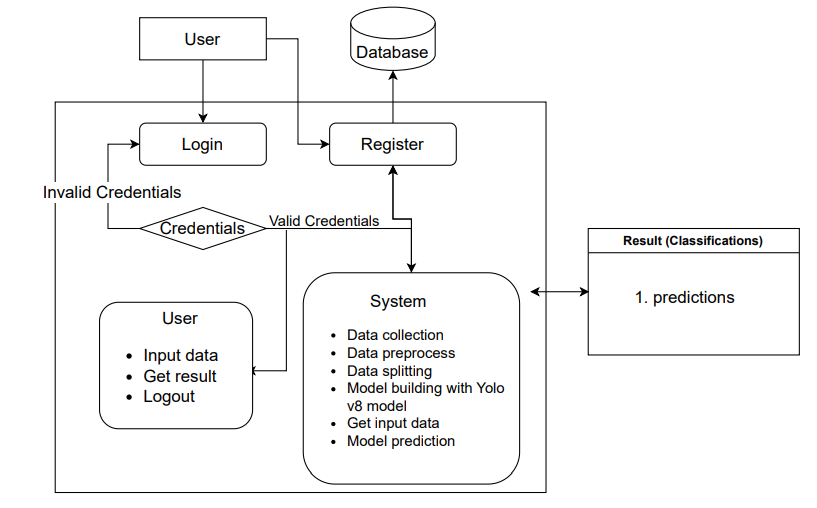
Block Diagram
Specifications
Hardware Requirements
Operating system : Windows 7 or 7+
RAM : 8 GB
Hard disc or SSD : More than 500 GB
Processor : Intel 3rd generation or high or Ryzen with 8 GB Ram
Software Requirements:
Software’s : Python 3.10 or high version
IDE : Visual Studio Code.
Framework : Flask
IDE/Workbench : PyCharm
Technology : Python 3.6+
Server Deployment : Xampp Server
Database : MySQL

Demo Video


Request for Video
 Paper Publishing
Request Call Back
Would you like to receive a free callback now?
Choose the best time for callback:
Leave your message and we will contact you as soon as possible

6-2-85/B, Old Maternity Hospital Road, Thyagaraja Nagar, Tirupati, Andhra Pradesh – 517501
+91 9030333433
+91 9393939065
0877-2261612

Disclaimer - Takeoff Edu Group Projects are not associated or affiliated with IEEE in any way. The IEEE Projects mentioned here are mentioned in the context of student projects, whose ideas are derived from IEEE publications, not projects of or by IEEE.

