Steel Defect Detection Based on YOLO
Objective
The objective of this project is to accurately detect and classify various types of defects in steel surfaces, including crazing, inclusion, patches, pitted surfaces, rolled-in scale, and scratches. By utilizing the YOLOv12 (You Only Look Once version 12) deep learning algorithm, the project aims to automate the defect detection process in steel manufacturing, providing real-time, high-accuracy classifications. The system will enable seamless identification of defects in steel surfaces during production, thereby enhancing quality control, reducing human error, and ensuring consistent product quality. The primary goal is to develop an automated detection system that can improve the overall efficiency of steel manufacturing by detecting defects with precision, facilitating timely corrective actions, and reducing downtime in the production process.
Abstract
Steel defect detection plays a critical role in the quality control and maintenance of manufacturing processes, especially in the steel industry. This project presents a Steel Defect Detection system using the YOLOv12 (You Only Look Once) algorithm, which leverages deep learning for efficient and accurate defect classification. The system is trained to detect various defects such as crazing, inclusion, patches, pitted surfaces, rolled-in scale, and scratches in steel plates. The YOLOv12 model is employed for its ability to perform real-time object detection and classification with high accuracy, enabling the automatic identification of defects in steel surfaces. The system achieves notable performance metrics, including precision, recall, and F1-scores across different defect classes. For example, the "patches" class shows an impressive F1-score of 0.932, while other classes like "crazing" and "scratches" display significant detection capabilities as well. This project utilizes Python-based libraries and frameworks to train and evaluate the model, optimizing it for the specific needs of steel defect detection. The results demonstrate the potential of deep learning techniques, particularly YOLOv12, in enhancing industrial processes by automating defect detection, reducing human error, and improving the overall efficiency of quality control in steel production. The system contributes to advancing the automation of defect detection in the steel industry, ensuring better product quality and consistency in production lines.
Keywords: Steel Defect Detection, YOLOv12, Deep Learning, Object Detection, Industrial Quality Control, Crazing, Inclusion, Patches, Pitted Surface, Rolled-in Scale, Scratches, Machine Learning, Precision, Recall, F1-Score, Python.
NOTE: Without the concern of our team, please don't submit to the college. This Abstract varies based on student requirements.
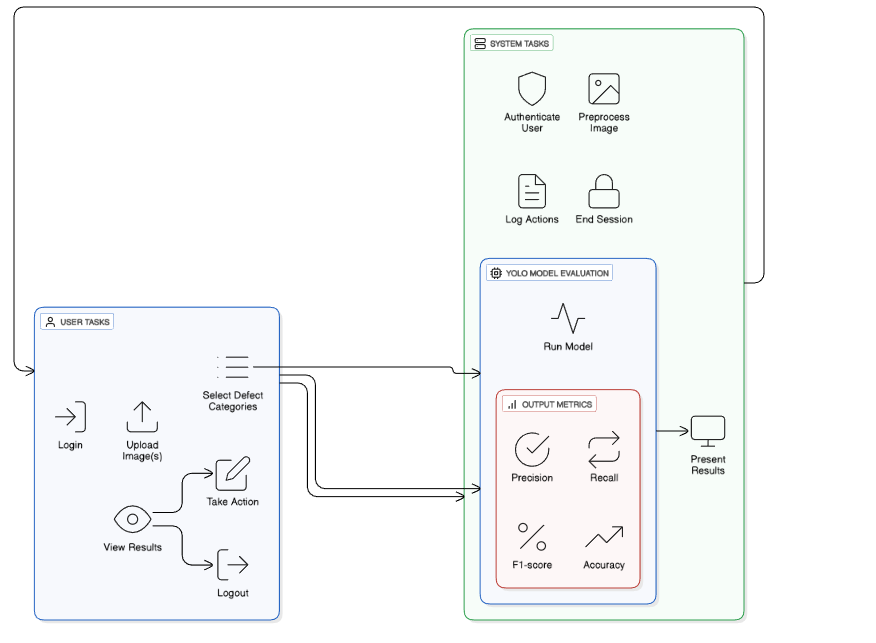
Block Diagram
Specifications
SOFTWARE REQUIREMENS
Operating System : Windows 7/8/10
Server side Script : streamlit
Programming Language : Python
Libraries : streamlit, Pandas, Torch, Keras, Sklearn, Numpy , Seaborn
IDE/Workbench : VSCode
Server Deployment : Xampp Server
Database : mysql
HARDWARE REQUIREMENTS
Processor - I3/Intel Processor
RAM - 8GB (min)
Hard Disk - 128 GB
Key Board - Standard Windows Keyboard
Mouse - Two or Three Button Mouse
Monitor - Any

Demo Video


Request for Video
 Paper Publishing
Request Call Back
Would you like to receive a free callback now?
Choose the best time for callback:
Leave your message and we will contact you as soon as possible

6-2-85/B, Old Maternity Hospital Road, Thyagaraja Nagar, Tirupati, Andhra Pradesh – 517501
+91 9030333433
+91 9393939065
0877-2261612

Disclaimer - Takeoff Edu Group Projects are not associated or affiliated with IEEE in any way. The IEEE Projects mentioned here are mentioned in the context of student projects, whose ideas are derived from IEEE publications, not projects of or by IEEE.

