Stator Resistance Estimation Using DC Injection with Reduced Torque Ripple in Induction Motor Sensorless Drives
Objective
The main objective of this project is to reduce torque ripples in the induction motor.
Abstract
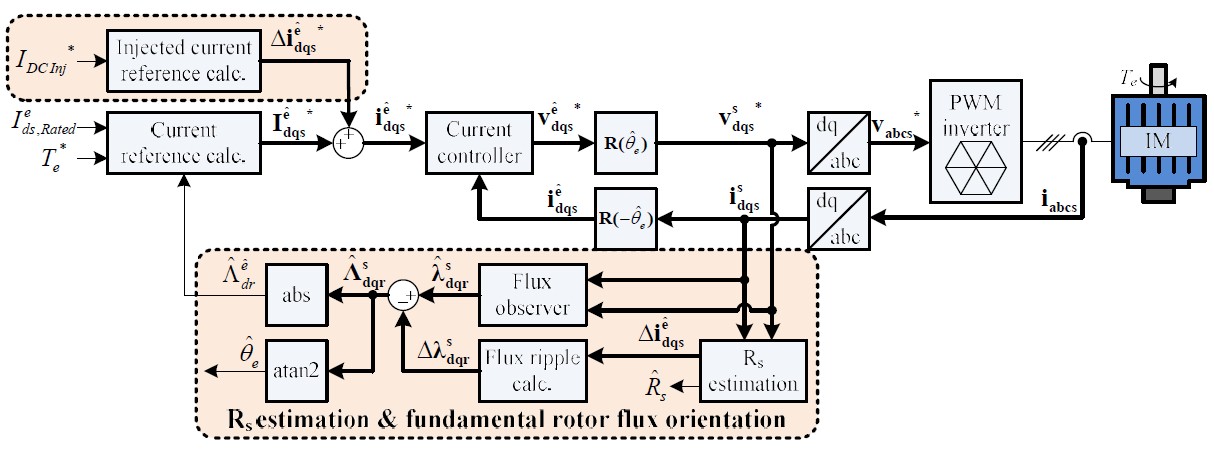
In this project, the torque ripple of an induction motor due to dc injection for the stator resistance estimation is analyzed. In the analysis, the fundamental component of rotor flux is used for rotor flux orientation to avoid the perturbation issue in synchronous reference speed.
On the synchronous reference frame, flux and torque fluctuation due to injected dc and arbitrary 2nd harmonic current is calculated. Furthermore, the current reference that nullifies the fundamental frequency torque ripple in the whole operating condition is proposed. An integral-based average filter is applied to extract dc signals in phase voltage and current. The proposed system is simulated in MATLAB/SIMULINK.
Keywords: Induction motors, DC signal injection, sensorless control, stator resistance estimation, torque ripple reduction.
NOTE: Without the concern of our team, please don't submit to the college. This Abstract varies based on student requirements.
Block Diagram
Specifications
Software Configuration:
Operating System : Windows 7/8/10
Application Software : Matlab/Simulink
Hardware Configuration:
RAM : 8 GB / 4 GB (Min)
Processor : I3 / I5(Mostly prefer)
Learning Outcomes
- Introduction to Matlab/Simulink
- What is EISPACK & LINPACK
- How to start with MATLAB
- About Matlab language
- About tools & libraries
- Application of Matlab/Simulink
- About Matlab desktop
- Features of Matlab/Simulink
- Basics on Matlab/Simulink
- Introduction to motors.
- Design of induction motor.
- Introduction to electrical drives.
- Analysis of power converters.
- Introduction to controllers.
- We can learn about synchronous reference frame theory.
- We can learn about Clark’s transformation.
- Design of pi controller.
- Introduction to the types of filters.
- Introduction to closed loop, open loop control methods.
- Study of PWM techniques.
- Design of SVPWM technique.
- Study of different torque ripple techniques.
- Study of different stator estimation techniques.
- Design of fundamental rotor flux orientation control.
- Project Development Skills:
- Problem analyzing skills
- Problem solving skills
- Creativity and imaginary skills
- Programming skills
- Deployment
- Testing skills
- Debugging skills
- Project presentation skills
- Thesis writing skills
Demo Video


Request for Video
 Paper Publishing
Request Call Back
Would you like to receive a free callback now?
Choose the best time for callback:
Leave your message and we will contact you as soon as possible

6-2-85/B, Old Maternity Hospital Road, Thyagaraja Nagar, Tirupati, Andhra Pradesh – 517501
+91 9030333433
+91 9393939065
0877-2261612

Disclaimer - Takeoff Edu Group Projects are not associated or affiliated with IEEE in any way. The IEEE Projects mentioned here are mentioned in the context of student projects, whose ideas are derived from IEEE publications, not projects of or by IEEE.

