State Of The Art Clustering Schemes In Mobile Ad Hoc Networks: Objectives, Challenges And Future Directions
Abstract
State of the art clustering schemes in mobile ad hoc networks: objectives, challenges and future directions
Abstract:
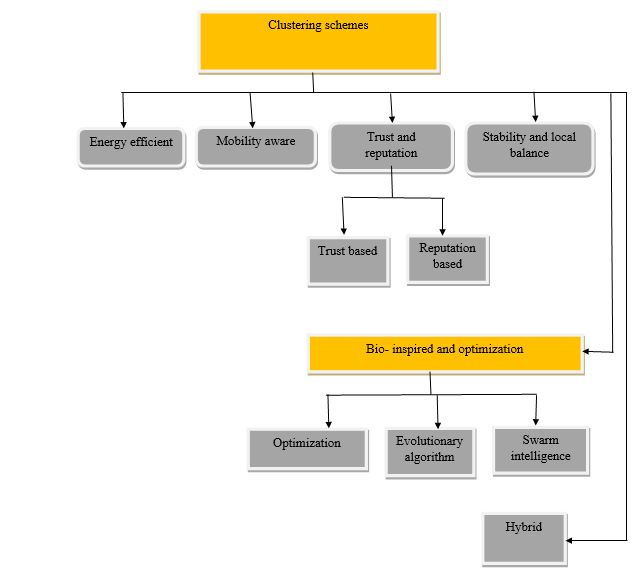
Mobile ad hoc Networks are self-organized networks without any fixed infrastructure. The topology changes are very frequent in MANETs due to nodes mobility. The topology maintenance creates an extra overhead because the mobility information of one node is shared to all nodes in the network. To address the topology maintenance overhead problem in MANETs, the researcher’s proposed different cluster based algorithms to reduce the size of a routing table. The clusters are formed to locally adjust the topology changes at intervals of the cluster. If a node wants to communicate with a node outside the cluster, it only communicates with its Cluster Head. The CH communicates with other CHs to transmit data towards the destination. To efficiently utilize the clustering mechanism in MANETs, stable and balanced clusters are required. To form good quality and optimized clusters, some metrics such as relative mobility node speed, direction, etc., node degree, residual energy, communication workload and neighbor’s behavior are required. In this, we have a tendency to contribute a comprehensive survey of recent CAs in MANETs. We also present the objectives, goals and contributions of recent research. Similarly, the findings, challenges and also the future directions are expressed. The validation of each proposed work is analyzed critically in terms of mobility model, simulation tool used throughout simulation, simulation metrics and the performance metrics used in the validation process.
NOTE: Without the concern of our team, please don't submit to the college. This Abstract varies based on student requirements.
Block Diagram
Specifications


 Paper Publishing

Request Call Back
Would you like to receive a free callback now?
Choose the best time for callback:
Leave your message and we will contact you as soon as possible

6-2-85/B, Old Maternity Hospital Road, Thyagaraja Nagar, Tirupati, Andhra Pradesh – 517501
+91 9030333433
+91 9393939065
0877-2261612

Disclaimer - Takeoff Edu Group Projects are not associated or affiliated with IEEE in any way. The IEEE Projects mentioned here are mentioned in the context of student projects, whose ideas are derived from IEEE publications, not projects of or by IEEE.

