Stacking Binary Neural Networks for Efficient Edge-Based Waste Classification
Objective
The objective of this project is to develop an efficient and automated system for the detection and classification of waste materials at the edge using advanced deep learning techniques. The system aims to classify waste items into six categories: Paper, Plastic, Glass, Can, Cardboard, Plastic Bottle, and Plastic Bag. By leveraging a combination of YOLOv26 for object detection, RT-DETR for robust localization, Grad-CAM for interpretability, and Soft-NMS for post-processing refinement, the project seeks to provide accurate and real-time waste classification, facilitating enhanced waste management and recycling processes.
Abstract
This project focuses on developing an efficient edge-based solution for waste classification using advanced deep learning techniques. The dataset includes various waste categories, including paper, plastic, glass, cans, cardboard, plastic bottles, and plastic bags. The objective is to create a system capable of accurately classifying and detecting these waste materials to support waste management efforts and recycling processes. To achieve high classification performance, a combination of YOLOv26, RT-DETR, Grad-CAM, and Soft-NMS is employed. YOLOv26 is used for real-time object detection, RT-DETR for robust and efficient object localization, while Grad-CAM provides visual explanations for model predictions, and Soft-NMS refines object detection results to minimize false positives. The model's performance is evaluated using precision, recall, and F1-score metrics. A user-friendly web application is developed to allow users to upload images of waste materials for real-time classification. This solution aids in automating waste sorting, contributing to more efficient recycling processes and promoting sustainable waste management practices.
Keywords: Waste Classification, YOLOv26, RT-DETR, Grad-CAM, Soft-NMS, Deep Learning, Edge-Based Systems, Object Detection, Recycling, Waste Management, Sustainable Practices.
NOTE: Without the concern of our team, please don't submit to the college. This Abstract varies based on student requirements.
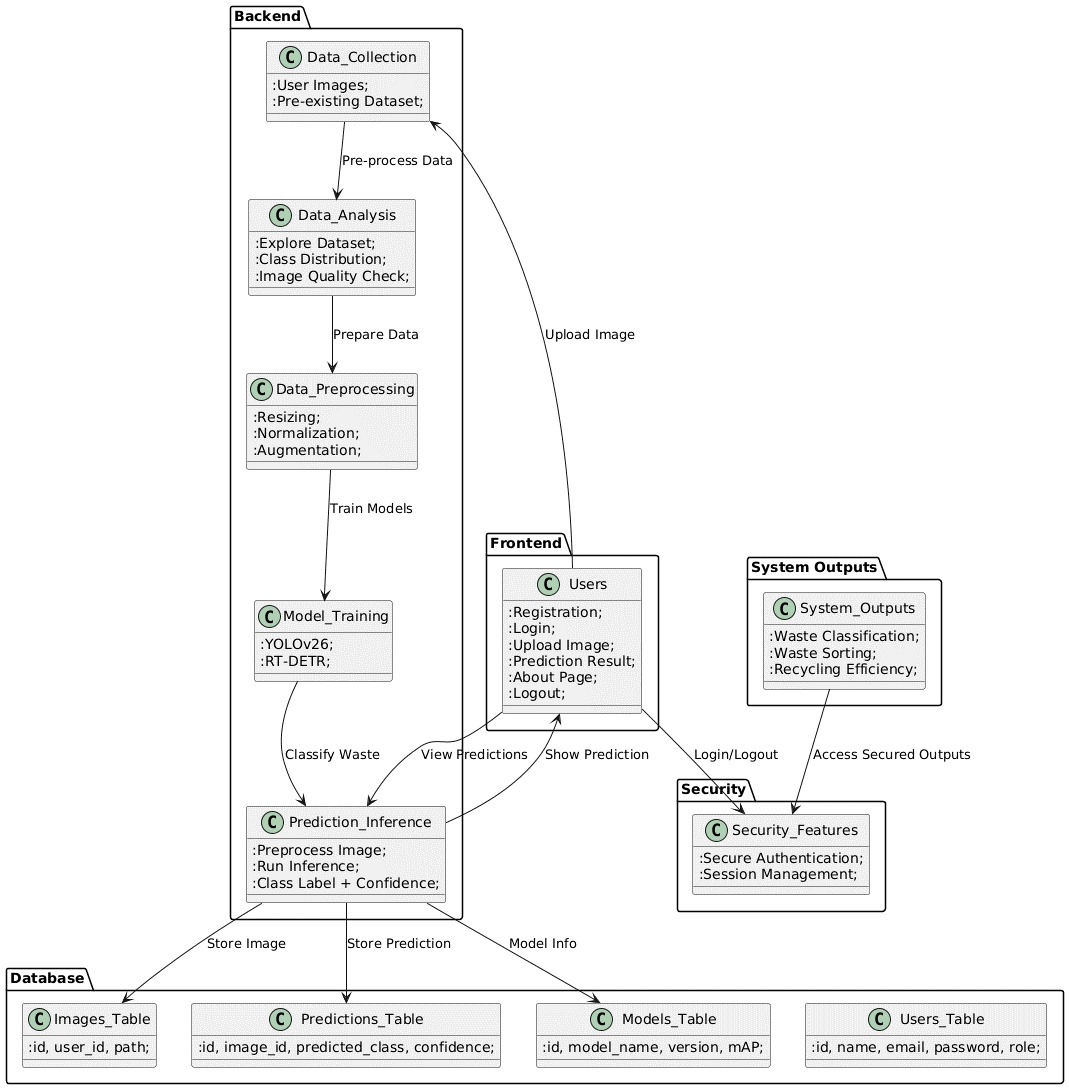
Block Diagram
Specifications
SOFTWARE REQUIREMENS
Operating System : Windows 7/8/10
Server-side Script : Streamlit
Programming Language : Python
Libraries : Flask, Pandas, Sklearn,Tensorflow NumPy, Seaborn, Matplotlib
IDE/Workbench : VSCode
Technology : Python 3.8+
Server Deployment : Xampp Server
Database : MySQL .
HARDWARE REQUIREMENTS
Processor - I5/Intel Processor
RAM - 8GB +(min)
Hard Disk - 128 +GB
Key Board - Standard Windows Keyboard
Mouse - Two or Three Button Mouse
Monitor - Any


 Paper Publishing

Request Call Back
Would you like to receive a free callback now?
Choose the best time for callback:
Leave your message and we will contact you as soon as possible

6-2-85/B, Old Maternity Hospital Road, Thyagaraja Nagar, Tirupati, Andhra Pradesh – 517501
+91 9030333433
+91 9393939065
0877-2261612

Disclaimer - Takeoff Edu Group Projects are not associated or affiliated with IEEE in any way. The IEEE Projects mentioned here are mentioned in the context of student projects, whose ideas are derived from IEEE publications, not projects of or by IEEE.

