SpectroGLY: A Low-Cost IoT-Based Ecosystem for the Detection of Glyphosate Residues in Waters
Objective
To develop SpectroGLY, an affordable IoT-based system for detecting glyphosate residues in water using spectral analysis and advanced sensors. The system aims to enable real-time monitoring and promote safe water quality management
Abstract
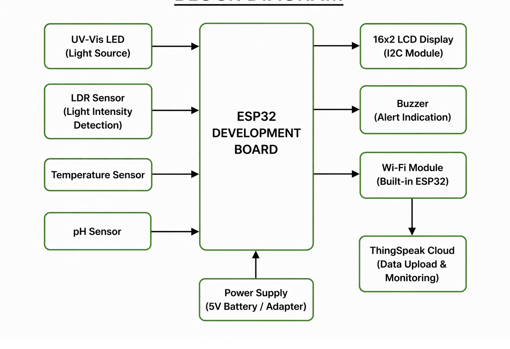
This project presents a low-cost IoT-based system for detecting glyphosate contamination in water using an optical sensing approach. A UV-Vis LED is used as a light source to pass light through the water sample, where the presence of glyphosate (after suitable chemical reaction) causes a change in light intensity. An LDR sensor measures the transmitted light and converts it into an electrical signal, which is processed by the ESP32 Development Board. The measured values are displayed in real time on a 16x2 LCD Display, while a Piezo Buzzer provides alerts when contamination exceeds predefined limits. Additional parameters such as temperature and pH can be monitored to improve accuracy. The processed data is transmitted over Wi-Fi and uploaded to the ThingSpeak cloud for remote monitoring and analysis. This system offers a simple, portable, and cost-effective solution for real-time water quality monitoring, making it suitable for environmental monitoring, agricultural applications, and public health safety.
NOTE: Without the concern of our team, please don't submit to the college. This Abstract varies based on student requirements.
Block Diagram
Specifications
Hardware components:
- ESP32
- UV-Vis LED
- LDR Sensor
- Temperature Sensor
- pH Sensor Module
- 16x2 LCD Display
- Buzzer
- Power Supply
Software components:
- Arduino IDE
- Embedded C
Learning Outcomes
- Understanding of ESP32 architecture and GPIO configuration
- Programming using Arduino IDE for ESP32
- Basics of Embedded C / Arduino programming for real-time systems
- Interfacing of UV-Vis LED and understanding light-based sensing
- Working and interfacing of LDR sensor for light intensity measurement
- Interfacing of temperature sensor for environmental monitoring
- Working and calibration of pH Sensor Module for liquid analysis
- Analog-to-Digital Conversion (ADC) using ESP32 for sensor data acquisition
- Interfacing of 16x2 LCD (I2C) for real-time data display
- Implementation of buzzer alerts for threshold-based indication
- Understanding of Wi-Fi communication using ESP32
- Data transmission to cloud platforms like ThingSpeak
- Real-time monitoring and analysis of multiple sensor parameters
- Development of an IoT-based monitoring system
- About Project Development Life Cycle:
- Planning and Requirement Gathering (software’s, Tools, Hardware components, etc.,)
- Schematic preparation
- Code development and debugging
- Hardware development and debugging
- Development of the Project and Output testing
- Practical exposure to:
- Hardware and software tools.
- Solution providing for real time problems.
- Working with team/ individual.
- Work on Creative ideas.
- Project development Skills
- Problem analyzing skills
- Problem solving skills
- Creativity and imaginary skills
- Programming skills
- Deployment
- Testing skills
- Debugging skills
- Project presentation skills
- Thesis writing skills


 Paper Publishing

Request Call Back
Would you like to receive a free callback now?
Choose the best time for callback:
Leave your message and we will contact you as soon as possible

6-2-85/B, Old Maternity Hospital Road, Thyagaraja Nagar, Tirupati, Andhra Pradesh – 517501
+91 9030333433
+91 9393939065
0877-2261612

Disclaimer - Takeoff Edu Group Projects are not associated or affiliated with IEEE in any way. The IEEE Projects mentioned here are mentioned in the context of student projects, whose ideas are derived from IEEE publications, not projects of or by IEEE.

