Solar Powered Unmanned Aerial Vehicle With Active Output Filter Under Non-Linear Load Conditions
Also Available Domains Power Quality|Electrical Vehicles
Objective
The objective of this paper is to propose Active Output Filter system AOF reduces the size and weight of the power transmission system while significantly improving its conversion efficiency.
Abstract
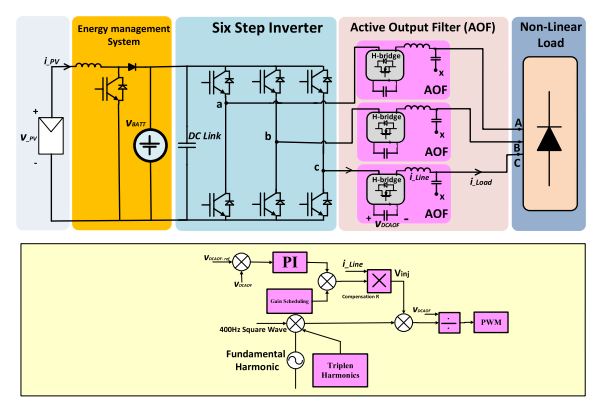
In this project, a new solar-powered unmanned aerial vehicle's electric powertrain (UAV) is proposed. The proposed system structure is based on the creation of a power supply system for both the Solong and Zyphyr aircraft models. The proposed UAV model incorporates the Zyphry UAV's use of an AC line feeder to power the propellers rather than DC power lines. Solar panels, an energy management system based on a lithium sulphide battery, an inverter, an AC bus-line, and an active output filter are all part of the proposed powertrain (AOF). The AOF topology is made up of a high switching frequency H-bridge inverter and a small LC filter. By incorporating an emulated series resistance with the H-bridge stage to ensure high quality pure sinusoidal waveform of the line voltage, the AOF system reduces the size and weight of the power transmission system while significantly improving its conversion efficiency.
This emulated series resistance produces an injected voltage across it to diminish unwanted harmonics created from the non-linear load. A simulation model setup is created to simulate the proposed system and the system is tested under non-linear load condition with closed-loop feed-back control strategy. The obtained simulation and experimental results demonstrate that high-quality sinusoidal line voltage waveforms can be obtained using the active resistance compensation technique with total harmonic distortion factor less than 3%.
Keywords: Active output filter, active resistance compensation, loss analysis, non-linear load, solar powered, unmanned aerial vehicle.
NOTE: Without the concern of our team, please don't submit to the college. This Abstract varies based on student requirements.
Block Diagram
Specifications
Software Configuration:
Operating System : Windows 7/8/10
Application Software : Matlab/Simulink
Hardware Configuration:
RAM : 8 GB
Processor : I3 / I5(Mostly prefer)
Learning Outcomes
- Introduction to Matlab/Simulink
- What is EISPACK & LINPACK
- How to start with MATLAB
- About Matlab language
- About tools & libraries
- Application of Matlab/Simulink
- About Matlab desktop
- Features of Matlab/Simulink
- Basics on Matlab/Simulink
- Introduction to batteries.
- Introduction to Solar Panels
- Design of batteries.
- Study of DC Source.
- Study of dc link voltage regulation
- Design of six step Inverter
- Introduction to Active output filter
- Design of cascaded H bridge Multi level Inverter
- Introduction to Multi level Inverters
- Introduction to PWM techniques
- Design of Multi-Level Inverters.
- Design of Cascaded H Bridge Multi level Inverters.
- Introduction to Voltage Source Inverters.
- Analysis of Gating pulses.
- Introduction to IGBT switches.
- Introduction to PI Controllers
- Introduction to linear loads
- Introduction to nonlinear loads
- We can learn about PI Controllers.
- We can learn about TRIAC’S.
- Study of PWM techniques.
- Design of PWM techniques.
- Study of energy storage systems.
- Study of Phase Locked Loops
- Study of pulse generators
- Project Development Skills:
- Problem analyzing skills
- Problem solving skills
- Creativity and imaginary skills
- Programming skills
- Deployment
- Testing skills
- Debugging skills
- Project presentation skills
- Thesis writing skills
Demo Video


Request for Video
 Paper Publishing
Request Call Back
Would you like to receive a free callback now?
Choose the best time for callback:
Leave your message and we will contact you as soon as possible

6-2-85/B, Old Maternity Hospital Road, Thyagaraja Nagar, Tirupati, Andhra Pradesh – 517501
+91 9030333433
+91 9393939065
0877-2261612

Disclaimer - Takeoff Edu Group Projects are not associated or affiliated with IEEE in any way. The IEEE Projects mentioned here are mentioned in the context of student projects, whose ideas are derived from IEEE publications, not projects of or by IEEE.
