Solar panel defect detection using Deep Learning
Objective
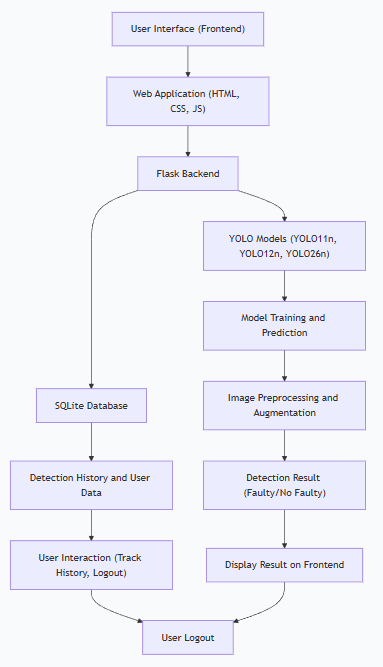
The main objectives of this project are to develop an automated system for detecting defects in solar panels using deep learning models and to integrate this system into a user-friendly web application. First, the project aims to preprocess and augment the dataset of solar panel images to ensure robust training of the YOLO models. The second objective is to implement three variations of the YOLO algorithm YOLO11n, YOLO12n, and YOLO26n each optimized for detecting faults in solar panels with high accuracy. The third objective is to evaluate the performance of each model based on validation metrics such as mean Average Precision (mAP) at different thresholds, ensuring that the models achieve reliable results for defect classification. Furthermore, the project seeks to develop a web-based interface for users to upload images, view live detection results, and track detection history. The backend will be built using Flask and SQLite, while the frontend will be developed using HTML, CSS, and JavaScript. Ultimately, the project aims to provide an automated, efficient solution for solar panel defect detection that can be scaled for use in large solar farms or individual installations, contributing to more efficient and cost-effective solar energy systems.
Abstract
The project titled "Solar Panel Defect Detection Using Deep Learning" focuses on identifying defects in solar panels using advanced deep learning algorithms, including YOLO11n, YOLO12n, and YOLO26n. The goal is to create a system capable of accurately detecting faulty panels based on image data, thus improving the efficiency of solar panel maintenance and monitoring. The project utilizes a dataset of images labeled as "faulty" and "no faulty," which were obtained through Roboflow. The system processes these images to classify panels into two categories, leveraging the YOLO family of models for object detection. The results show high validation mean Average Precision (mAP) at different thresholds, mAP@0.5 and mAP@0.5:0.95. The project also includes a web application with modules for registration, login, live detection, and history tracking, built using Flask and SQLite for back-end support and HTML, CSS, and JavaScript for the front-end. The system aims to streamline the defect detection process for solar panels, improving overall performance and reducing manual inspection time.
Keywords: Solar panel defect detection, deep learning, YOLO,
object detection, mAP, image classification, Flask, SQLite, web application,
automated inspection.
NOTE: Without the concern of our team, please don't submit to the college. This Abstract varies based on student requirements.
Block Diagram
Specifications
HARDWARE REQUIREMENTS
Processor - I3/Intel Processor
Hard Disk - 160GB
Key Board - Standard Windows Keyboard
Mouse - Two or Three Button Mouse
Monitor - SVGA
RAM - 8GB
SOFTWARE REQUIREMENTS:
Operating System : Windows 7/8/10
Server side Script : HTML, CSS
Programming Language : Python
Libraries : Flask, Os, pandas, Scikit-learn, Numpy, tensoflow
IDE/Workbench : VsCode
Technology : Python 3.8+
Database : sqllite


 Paper Publishing

Request Call Back
Would you like to receive a free callback now?
Choose the best time for callback:
Leave your message and we will contact you as soon as possible

6-2-85/B, Old Maternity Hospital Road, Thyagaraja Nagar, Tirupati, Andhra Pradesh – 517501
+91 9030333433
+91 9393939065
0877-2261612

Disclaimer - Takeoff Edu Group Projects are not associated or affiliated with IEEE in any way. The IEEE Projects mentioned here are mentioned in the context of student projects, whose ideas are derived from IEEE publications, not projects of or by IEEE.

