Soil Fertility Prediction A Machine Learning Approach for Modern Agriculture
Objective
This project focuses on predicting soil fertility using a hybrid Random Forest (RF) and quantum computing–based approach. Soil attributes such as nitrogen, phosphorus, potassium, pH, and moisture are processed using RF techniques combined with quantum algorithms like Quantum SVM, enabling faster pattern discovery and improved decision accuracy. The system analyzes soil parameters and classifies fertility levels through quantum-driven computation rather than traditional machine-learning pipelines. A simple interface allows users to input soil data and instantly receive fertility predictions. This quantum-enhanced method supports precise nutrient management, reduces fertilizer waste, and promotes sustainable agriculture.
Abstract
Soil fertility assessment plays a vital role in precision agriculture, helping farmers make informed decisions related to crop selection, nutrient management, and sustainable resource utilization. However, conventional soil testing methods, although reliable, are often time-consuming, labor-intensive, and costly. To address these challenges, this project introduces a machine learning–based soil fertility prediction framework enhanced with quantum-inspired computational techniques. The system analyzes key soil attributes—including pH, electrical conductivity, organic matter, and essential nutrient concentrations—to predict soil fertility with improved accuracy and efficiency. A quantum-inspired methodology is employed using cosine–sine–based single-qubit encoding and quantum entanglement modeling to convert classical soil features into high-dimensional quantum states. This transformation captures deeper, non-linear interactions within the soil data, enabling more robust classification than traditional feature representations.
Experimental evaluation demonstrates that the Quantum-Enhanced Random Forest (QRF) model achieves superior accuracy, stability, and generalization compared to classical approaches. The integration of quantum feature embedding strengthens decision boundaries, reduces the influence of noisy inputs, and enhances the model’s capability to interpret complex soil patterns. The results highlight the significant potential of hybrid quantum–machine learning techniques in the agricultural domain, offering faster computation and higher predictive reliability. This work contributes to the emerging field of quantum agriculture and emphasizes its relevance in advancing sustainable, data-driven farming workflows for modern agriculture.
Keywords: Soil Fertility, Quantum Machine Learning, Quantum-Enhanced Random Forest, Quantum Encoding, Precision Agriculture, Feature Entanglement, Hybrid Quantum Models.
NOTE: Without the concern of our team, please don't submit to the college. This Abstract varies based on student requirements.
Block Diagram
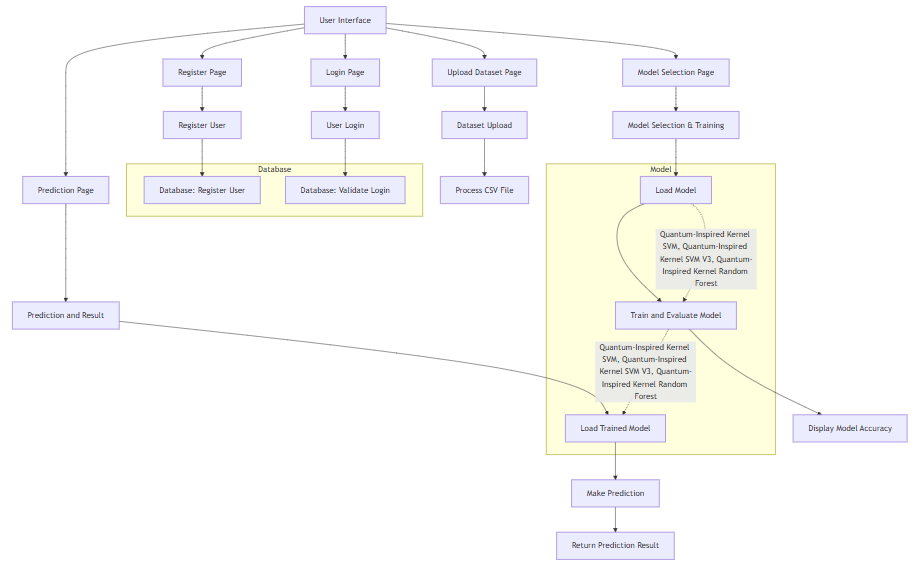
Specifications
SOFTWARE REQUIREMENS
Operating System : Windows 7/8/10
Server side Script : HTML, CSS, Bootstrap & JS
Programming Language : Python
Libraries : Flask, Pandas, Torch, Keras, Sklearn,Numpy , Seaborn
IDE/Workbench : VSCODE
Server Deployment : Xampp Server
Database : MySQL
HARDWARE REQUIREMENTS
Processor - I3/Intel Processor
RAM - 8GB (min)
Hard Disk - 128 GB
Key Board - Standard Windows Keyboard
Mouse - Two or Three Button Mouse
Monitor - Any


 Paper Publishing

Request Call Back
Would you like to receive a free callback now?
Choose the best time for callback:
Leave your message and we will contact you as soon as possible

6-2-85/B, Old Maternity Hospital Road, Thyagaraja Nagar, Tirupati, Andhra Pradesh – 517501
+91 9030333433
+91 9393939065
0877-2261612

Disclaimer - Takeoff Edu Group Projects are not associated or affiliated with IEEE in any way. The IEEE Projects mentioned here are mentioned in the context of student projects, whose ideas are derived from IEEE publications, not projects of or by IEEE.

