Smart system electricity power companies
Objective
The primary objective of this project is to design and develop a smart system for electricity power companies that enhances the efficiency, reliability, and sustainability of electricity distribution networks.
Abstract
ABSTRACT
The integration of smart systems in electricity power companies has emerged as a revolutionary approach to enhance the efficiency, reliability, and sustainability of power distribution and management. Smart systems, driven by advanced technologies such as Internet of Things (IoT), Artificial Intelligence (AI), and data analytics, enable power companies to monitor, control, and optimize electricity grids in real-time. These systems are designed to adapt to fluctuating demand, integrate renewable energy sources, and address challenges related to energy conservation and cost reduction.Smart grids, which form the core of smart systems in electricity power companies, employ sensors, communication networks, and automation tools to improve grid performance. These grids enable real-time data collection, allowing for quick identification of faults, better load management, and predictive maintenance, thus minimizing downtime and service interruptions. Additionally, smart meters play a significant role by providing customers with detailed insights into their energy consumption, fostering more conscious energy use and contributing to demand-side management.The benefits of smart systems extend to both power companies and consumers. For utility companies, smart systems lead to reduced operational costs, improved grid resilience, and enhanced integration of renewable energy sources such as solar and wind. Consumers, on the other hand, experience more reliable electricity services, greater transparency in billing, and potential cost savings through demand-response programs that encourage energy usage during off-peak hours. Furthermore, these systems contribute to a reduction in carbon emissions, supporting the transition towards greener and more sustainable energy systems.Despite the numerous advantages, the implementation of smart systems also presents challenges, including the need for substantial investment, cybersecurity risks, and the complexity of integrating new technologies into existing infrastructure. Overcoming these challenges requires collaboration between government bodies, energy providers, and technology developers, alongside a focus on regulatory frameworks that ensure the equitable distribution of benefits from smart grids.In conclusion, the adoption of smart systems by electricity power companies is an essential step toward creating a more efficient, resilient, and sustainable energy future. By leveraging cutting-edge technologies, smart systems can transform how electricity is produced, distributed, and consumed, benefiting both providers and end-users while contributing to global sustainability goals.
Keywords: Smart systems, electricity power companies, smart grids, renewable energy, energy efficiency, Internet of Things (IoT), Artificial Intelligence (AI), data analytics, smart meters, demand-side management, sustainable energy, smart grid technology, grid resilience, energy transition, carbon emissions.
NOTE: Without the concern of our team, please don't submit to the college. This Abstract varies based on student requirements.
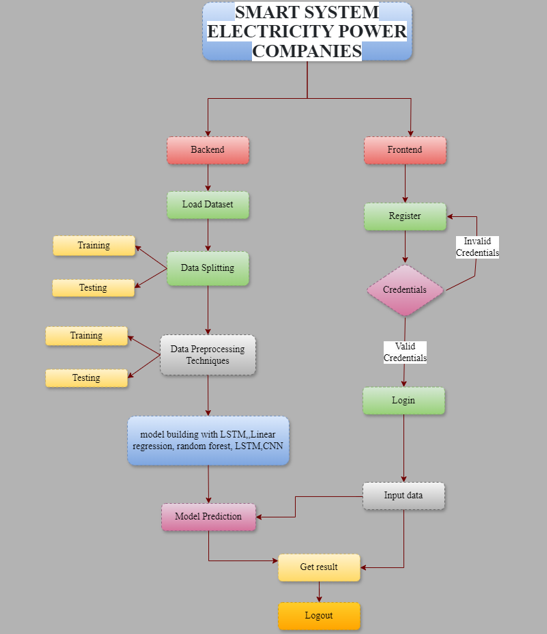
Block Diagram
Specifications
SOFTWARE AND HARDWARE REQUIREMENTS:
Hardware:
Operating system : Windows 7 or 7+
RAM : 8 GB
Hard disc or SSD : More than 500 GB
Processor : Intel 3rd generation or high or Ryzen with 8 GB Ram
Software:
Software’s : Python 3.10 or high version
IDE : Visual Studio Code.
Framework : Flask


 Paper Publishing

Request Call Back
Would you like to receive a free callback now?
Choose the best time for callback:
Leave your message and we will contact you as soon as possible

6-2-85/B, Old Maternity Hospital Road, Thyagaraja Nagar, Tirupati, Andhra Pradesh – 517501
+91 9030333433
+91 9393939065
0877-2261612

Disclaimer - Takeoff Edu Group Projects are not associated or affiliated with IEEE in any way. The IEEE Projects mentioned here are mentioned in the context of student projects, whose ideas are derived from IEEE publications, not projects of or by IEEE.

