Smart Stick to Detect wildlife Animals for Trekkers Using Raspberry Pi
Objective
The objective is to develop a portable Raspberry Pi–based smart stick that detects nearby wildlife and provides real-time alerts to ensure trekkers’ safety during outdoor activities.
Abstract
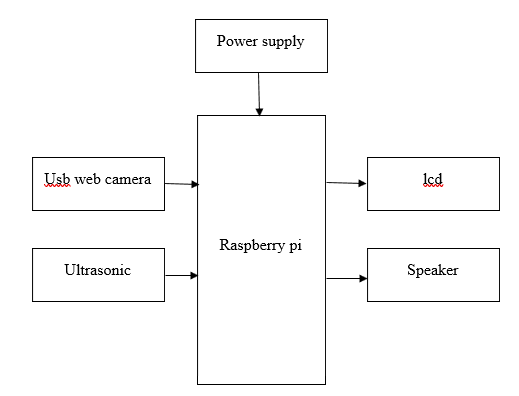
This project presents a Smart Stick designed to enhance the safety of trekkers by detecting the presence of wildlife animals using a Raspberry Pi-based system. Equipped with an ultrasonic sensor and a USB webcam, the stick detects nearby animals through distance measurement and visual recognition. Upon detection, the system alerts the user with audio signals via a 3.5mm mini speaker and buzzer, while displaying relevant information on an LCD screen for real-time awareness. Powered by a 12V adapter and supported by a memory card for data storage, this portable and user-friendly device aims to prevent unexpected encounters with wild animals, improving the trekking experience in forested or wildlife-prone areas. The integration of these components into a single smart stick offers an effective tool for trekkers to navigate safely in natural environments.
Keywords: Smart Stick, Wildlife Detection, Trekking Safety, Raspberry Pi, Ultrasonic Sensor ,USB Webcam, Animal Recognition, Audio Alert System, LCD Display
NOTE: Without the concern of our team, please don't submit to the college. This Abstract varies based on student requirements.
Block Diagram
Specifications
Hardware requirements:
- Raspberry pi
- Memory card
- Usb web camera
- Ultrasonic sensor
- Lcd
- Power supply
- Mini speaker
Software requirements:
- Raspbean os
- Python idle
Learning Outcomes
Understanding Raspberry pi pin diagram and architecture
Installing and configuring python IDE for Raspberry pi
Setting up Raspberry pi for multi-sensor
Basic coding with Raspberry pi for applications
Interfacing LCD with Arduino for real-time display
Interfacing usb web camera with Raspberry pi
Interfacing Ultrasonic sensor with Raspberry pi
Interfacing mini speaker with Raspberry pi
Understanding power supply requirements for wearable devices
About Project Development Life Cycle:
- Planning and Requirement Gathering (software, tools, hardware components, etc.)
- Schematic preparation
- Code development and debugging
- Hardware setup and debugging
- Development of the Project and Output testing
Practical exposure to:
- Hardware and software tools
- Solution providing for real-time problems
- Working with a team/individually
- Working on creative ideas
Project development skills:
- Problem analysis
- Problem solving
- Creativity and imagination
- Programming skills (Python)
- Deployment
- Testing
- Debugging
- Project presentation
- Report writing


 Paper Publishing

Request Call Back
Would you like to receive a free callback now?
Choose the best time for callback:
Leave your message and we will contact you as soon as possible

6-2-85/B, Old Maternity Hospital Road, Thyagaraja Nagar, Tirupati, Andhra Pradesh – 517501
+91 9030333433
+91 9393939065
0877-2261612

Disclaimer - Takeoff Edu Group Projects are not associated or affiliated with IEEE in any way. The IEEE Projects mentioned here are mentioned in the context of student projects, whose ideas are derived from IEEE publications, not projects of or by IEEE.

