Smart Horticultural Lighting Systems: Leveraging IoT for Enhanced Plant Growth and Agricultural Efficiency
Objective
The objective of this project is to develop and implement an IoT-integrated horticultural lighting system that optimizes plant growth and improves agricultural operations. By utilizing real-time sensor data to adjust lighting parameters such as spectrum, intensity, and duration, the system aims to enhance plant health, maximize yields, and improve resource efficiency. This adaptive approach will enable precision farming, reduce energy consumption, and contribute to sustainable agricultural practices.
Abstract
The Internet of Things (IoT) and horticulture lighting systems may improve plant growth and agricultural operations. The variation in the light spectrum, intensities, and durations affect plant physiological systems. The proposed system can dynamically adjust and control lighting settings using real-time sensor data by seamlessly integrating IoT capabilities. These sensors carefully track plant health, ambient conditions, and energy use. This dynamic feedback system allows operators to make informed choices and adjust lighting techniques for optimum growth, yields, and resource use. Plant growth and resource efficiency benefit from light parameter improvement. The connection between IoT and horticulture lighting leads to sustainable agriculture that maximizes agricultural yields and energy efficiency. Moving from static to adaptive lighting systems represents a paradigm change in agriculture, as data-driven decisions enable precision farming. Combining IoT’s real-time abilities with horticulture lighting systems promises unique yields, energy savings, and sustainable agriculture practices.
NOTE: Without the concern of our team, please don't submit to the college. This Abstract varies based on student requirements.
Block Diagram
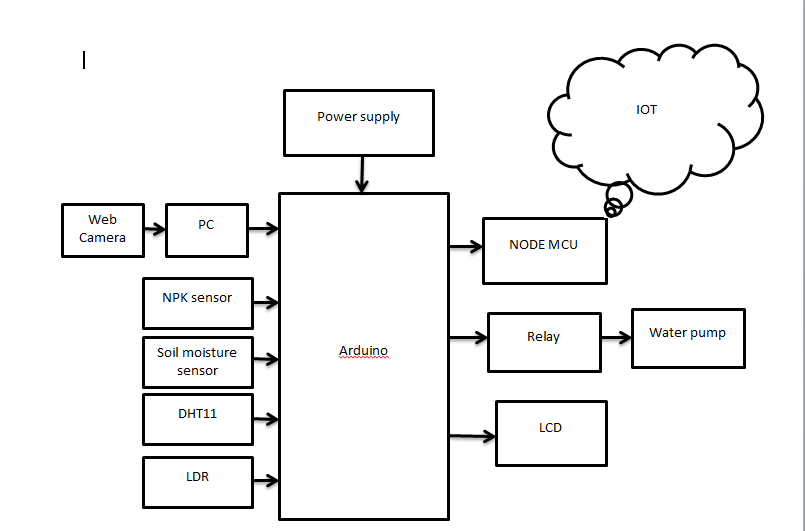
Specifications
Hardware Requirements:
- Arduino
- Soil Moisture sensor
- NPKSensor
- LCD
- RELAY
- Water pump
- NODE MCU
- LDR Sensor
- Web Camera
- DHT 11
- Load Cell
- IP Cemera
- GSM
- Power supply
Software Requirements:
- Arduino IDE
- Embedded C
- python
Learning Outcomes
Learning outcomes:
- Arduino Pin diagram and Architecture
- Installation for Arduino IDE
- Basic coding in Embedded C
- Working of NPK sensor
- How to connect NPK sensor to Arduino?
- Working of DHT11
- How to connect DHT11 to Arduino?
- Working of LCD
- Working of Relay ?
- Working of soilMoisture sensor ?
- How to connect LCD to Arduino?
- Working of LDR?
- How to connect LDR to Arduino?
- Introduction to serial communication
- About Project Development Life Cycle:
- Planning and Requirement Gathering (software’s, Tools, Hardware components, etc.,)
- Schematic preparation
- Code development and debugging
- Hardware development and debugging
- Development of the Project and Output testing
- Practical exposure to:
- Hardware and software tools.
- Solution providing for real time problems.
- Working with team/ individual.
- Work on Creative ideas.
- Project development Skills
- Problem analyzing skills
- Problem solving skills
- Creativity and imaginary skills
- Programming skills
- Deployment
- Testing skills
- Debugging skills
- Project presentation skills
- Thesis writing skills


 Paper Publishing

Request Call Back
Would you like to receive a free callback now?
Choose the best time for callback:
Leave your message and we will contact you as soon as possible

6-2-85/B, Old Maternity Hospital Road, Thyagaraja Nagar, Tirupati, Andhra Pradesh – 517501
+91 9030333433
+91 9393939065
0877-2261612

Disclaimer - Takeoff Edu Group Projects are not associated or affiliated with IEEE in any way. The IEEE Projects mentioned here are mentioned in the context of student projects, whose ideas are derived from IEEE publications, not projects of or by IEEE.

