Objective
The main theme is to design a helmet that is integrated with a circuit to sense the rain and automatically starts to wipe the helmets eye shield
Abstract
The Smart Helmet Wiper is a technologically advanced solution designed to enhance rider safety and comfort while wearing a helmet in adverse weather conditions. Utilizing an ARM 7 Micro processing Unit (MPU) as its brain, this innovation incorporates a user-friendly switch interface and a rain sensor for input. Information and status updates are conveniently displayed on an LCD screen. When the user activates the switch or when the rain sensor detects rain or water drops, a buzzer alerts the user, and the integrated DC motor (L293D motor driver) and wiper mechanism are engaged in unison. This synchronized operation effectively clears the helmet's face shield, ensuring optimal visibility and safety for the rider, whether in the presence of rain or simply when the rider desires a clearer view. The Smart Helmet Wiper combines technology and functionality to offer a seamless and effective solution for helmet-wearing and following traffic rules.
Keywords: ARM7, Rain sensor, switch, wiper, LCD, L293D motor driver, DC motor, Buzzer.
NOTE: Without the concern of our team, please don't submit to the college. This Abstract varies based on student requirements.
Block Diagram
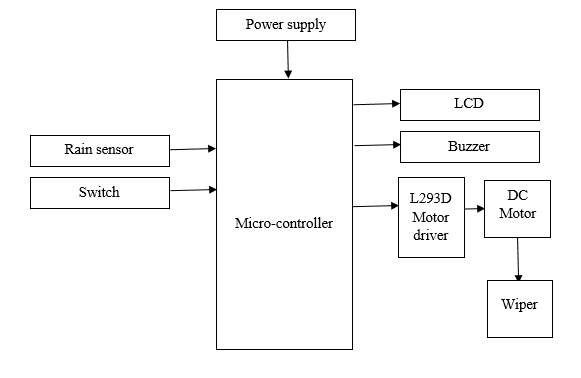
Specifications
Hardware components:
- Power supply
- ARM7 controller
- Rain sensor
- Switch
- LCD
- Buzzer
- DC motor
- L293D motor drivers
- Wiper
Software components:
- Embedded C
- Keil software
Learning Outcomes
- Architecture ARM7 controller
- Keil software
- How to install the keil software
- Rain sensor working
- Interfacing of motor with L293D motor driver
- Buzzer working
- Working of LCD
- Interface LCD with controller?
- Working of power supply
- About Project Development Life Cycle:
- Planning and Requirement Gathering( software’s, Tools, Hardware components, etc.,)
- Schematic preparation
- Code development and debugging
- Hardware development and debugging
- Development of the Project and Output testing
- Practical exposure to:
- Hardware and software tools.
- Solution providing for real time problems.
- Working with team/ individual.
- Work on Creative ideas.
- Project development Skills
- Problem analyzing skills
- Problem solving skills
- Creativity and imaginary skills
- Programming skills
- Deployment
- Testing skills
- Debugging skills
- Project presentation skills
- Thesis writing skills


 Paper Publishing

Request Call Back
Would you like to receive a free callback now?
Choose the best time for callback:
Leave your message and we will contact you as soon as possible

6-2-85/B, Old Maternity Hospital Road, Thyagaraja Nagar, Tirupati, Andhra Pradesh – 517501
+91 9030333433
+91 9393939065
0877-2261612

Disclaimer - Takeoff Edu Group Projects are not associated or affiliated with IEEE in any way. The IEEE Projects mentioned here are mentioned in the context of student projects, whose ideas are derived from IEEE publications, not projects of or by IEEE.

