Smart Helmet Detection Accident and Alcohol Detection Using GPS & GSM
Objective
The main objective of this project is to find the vehicle where it is and locate the vehicle by means of sending a message using a system which is placed inside of vehicle system
Abstract
With the growing number of 2-wheel motor vehicles, the frequency of accidents is on the rise. A major portion of the fatalities occur because the person was either not wearing a helmet, or his accident was not reported in time, and he could not be saved because of the delayed admittance to a hospital, or because he was riding while drunk. We propose mechanisms that can detect if one is wearing the helmet, detect accidents, and detect whether the person has over-consumed alcohol. For this purpose, we use onboard sensors – gas Sensor, mems sensor. The accelerometer measures the change in tilt, in X Y and Z axes respectively, and sends the data to a server via an online application programming interface (API). The breath analyzer senses the amount of alcohol present in the breath of a person wearing the helmet and reports if it is beyond the legal limit. This can help optimize accident detection in the future when enough data is gathered to provide reliable accuracy. This will ensure the holistic safety of the rider at all times.
This project presents an alert of the accident detection techniques by using smart helmet detection. The purpose of the project is to find the vehicle where it is and locate the vehicle by means of sending a message using a system which is placed inside of vehicle system Most of the times we may not be able to find accident location because we don’t know where accident will happen. Our project Real Time Vehicle Tracking and Accident Detection with GSM is designed to avoid such situations by using Hybrid electricity.
Keywords: Arduino uno, Mems sensor, GPS, Switch, GSM, Buzzer, Relay, DC motor, power supply
NOTE: Without the concern of our team, please don't submit to the college. This Abstract varies based on student requirements.
Block Diagram
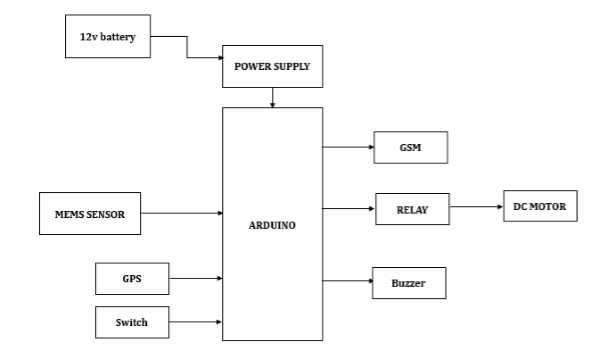
Specifications
- Arduino Uno
- Mems sensor
- GPS
- Switch
- GSM
- Relay
- DC motor
- Buzzer
- power supply
- Arduino IDE
- Fritzing
Learning Outcomes
- Arduino pin diagram and architecture
- How to install Arduino IDE software
- Setting up and installation procedure for Arduino
- Introduction to Arduino IDE
- Basic coding in Arduino IDE
- Working of MEMS sensor
- Interface MEMS sensor with Arduino?
- Working of Relay
- Interface Relay with Arduino?
- Working of DC motor
- Interface DC motor with Arduino?
- Working of GPS
- Interface GPS with Arduino?
- Working of GSM
- Interface GSM with Arduino?
- Working of Switch
- Interface Switch with Arduino?
- Working of Buzzer
- Interface Buzzer with Arduino?
- Working of power supply
- About Project Development Life Cycle:
- Planning and Requirement Gathering( software’s, Tools, Hardware components, etc.,)
- Schematic preparation
- Code development and debugging
- Hardware development and debugging
- Development of the Project and Output testing
- Practical exposure to:
- Hardware and software tools.
- Solution providing for real time problems.
- Working with team/ individual.
- Work on Creative ideas.
- Project development Skills
- Problem analyzing skills
- Problem solving skills
- Creativity and imaginary skills
- Programming skills
- Deployment
- Testing skills
- Debugging skills
- Project presentation skills
- Thesis writing skills
Demo Video


Request for Video
 Paper Publishing
Request Call Back
Would you like to receive a free callback now?
Choose the best time for callback:
Leave your message and we will contact you as soon as possible

6-2-85/B, Old Maternity Hospital Road, Thyagaraja Nagar, Tirupati, Andhra Pradesh – 517501
+91 9030333433
+91 9393939065
0877-2261612

Disclaimer - Takeoff Edu Group Projects are not associated or affiliated with IEEE in any way. The IEEE Projects mentioned here are mentioned in the context of student projects, whose ideas are derived from IEEE publications, not projects of or by IEEE.

