Smart Guiding Glasses For Visually Impaired People In Indoor Environment Using Arduino
Also Available Domains Arduino
Objective
The main objective of this project is to navigate visually impaired people in an indoor environment with the help of raspberry pi by identifying the objects that are present in his path and guiding him through speech via headphones.
Abstract
To overcome difficulty in indoor environment for the visually impaired group, this project presents a novel ETA (Electronic Travel Aids)-smart guiding device in the shape of a pair of eyeglasses for giving these people guidance efficiently and safely. Different from existing works, a novel multi-sensor fusion based obstacle avoiding algorithm is proposed, which utilizes both the soil moisture sensor and an ultrasonic sensor to solve the problems of detecting small obstacles, and transparent obstacles, e.g. the French door. This system developed to inform the direction where they can go ahead for Blind people. The prototype consisting of a camera and an ultrasonic sensor is developed, and its efficiency and accuracy were tested by several users. The experimental results show that smart guiding glasses can effectively improve the user’s traveling experience in the complicated indoor environment. Thus it serves as a consumer device for helping the visually impaired people to travel safely
NOTE: Without the concern of our team, please don't submit to the college. This Abstract varies based on student requirements.
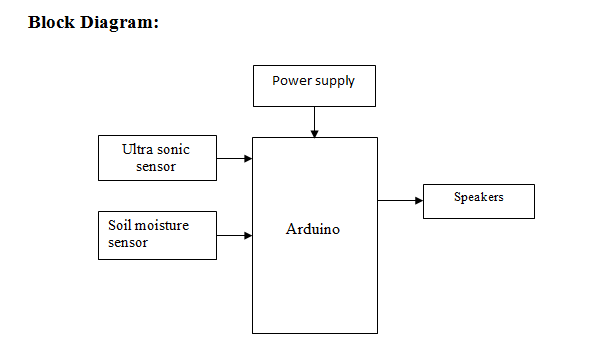
Block Diagram
Specifications
Learning Outcomes
- Arduino Pin diagram and Architecture
- How to install Arduino IDE Software
- Setting up and Installation procedures for Arduino IDE
- Introduction to Arduino IDE
- Commands in Embedded C
- How to install Libraries?
- Basic coding in Embedded C
- Working of Ultrasonic sensor
- How to interface Soil moisture sensor with Arduino
- About Project Development Life Cycle:
- Planning and Requirement Gathering (software’s, Tools, Hardware components, etc.,)
- Schematic preparation
- Code development and debugging
- Hardware development and debugging
- Development of the Project and Output testing
- Practical exposure to:
- Hardware and software tools.
- Solution providing for real time problems.
- Working with team/ individual.
- Work on Creative ideas.
- Project development Skills
- Problem analyzing skills
- Problem solving skills
- Creativity and imaginary skills
- Programming skills
- Deployment
- Testing skills
- Debugging skills
- Project presentation skills
- Thesis writing skills


 Paper Publishing

Request Call Back
Would you like to receive a free callback now?
Choose the best time for callback:
Leave your message and we will contact you as soon as possible

6-2-85/B, Old Maternity Hospital Road, Thyagaraja Nagar, Tirupati, Andhra Pradesh – 517501
+91 9030333433
+91 9393939065
0877-2261612

Disclaimer - Takeoff Edu Group Projects are not associated or affiliated with IEEE in any way. The IEEE Projects mentioned here are mentioned in the context of student projects, whose ideas are derived from IEEE publications, not projects of or by IEEE.

