Smart Growth Strategies A Machine Learning Framework for Population-Driven Water and Energy Demand Forecasting in Urban Planning
Objective
This project develops an intelligent urban energy prediction system using machine learning and deep learning models to forecast energy demand based on population growth and urbanization factors. The framework integrates Random Forest, Decision Tree, Polynomial-Enhanced Population-Weighted Temporal Graph Transformer (PE-PWTGT) CPU Model, and a Deep Feedforward Neural Network(PAGET) for Energy Consumption Prediction to analyze demographic, environmental, and socioeconomic data. Advanced preprocessing and hybrid learning techniques improve prediction accuracy, robustness, and forecasting performance. The system supports smart city planning, energy optimization, and sustainable urban development through data-driven decision making
Abstract
This project presents a machine learning framework for forecasting per capita energy consumption using population-driven urbanization and climate metrics to support smart urban planning and sustainable resource management. The framework integrates Random Forest and Decision Tree models to analyze global urbanization patterns and predict energy demand (energy_kg_oil_eq_cap) based on key indicators such as total population, population density, GDP, urban and rural population percentages, access to electricity, safe sanitation access, renewable energy consumption, and CO₂ emissions. The dataset global_urbanization_climate_metrics.csv, covering the period 1960–2023 across multiple countries, underwent comprehensive preprocessing including mean imputation for missing values, removal of non-predictive columns, and exploratory data analysis with a correlation heatmap to uncover important relationships. Feature selection was performed using Mutual Information Regression, retaining the nine most influential variables for model training. The system employs supervised regression models, with the Random Forest Regressor delivering superior performance (Mean Squared Error: 391,052.34, R² Score: 0.896) compared to the Decision Tree Regressor (Mean Squared Error: 782,753.62, R² Score: 0.792). Both models were trained on a 67-33 train-test split and saved for deployment. By effectively capturing complex non-linear relationships between urbanization dynamics and energy consumption, the framework enables accurate demand forecasting that can guide strategic decisions in infrastructure development and resource allocation. This approach offers urban planners and policymakers a powerful, data-driven tool for anticipating future energy needs driven by population growth, supporting sustainable smart city initiatives, optimizing urban-rural resource distribution, and evaluating the long-term impact of development policies. The project highlights the potential of machine learning in transforming urbanization and climate data into actionable insights for resilient and sustainable urban growth.
Keywords: Urban Planning, Energy Demand Forecasting, Population Growth, Smart Cities, Random Forest, Decision Tree, Sustainable Development, Urbanization, Predictive Analytics, Feature Selection.
NOTE: Without the concern of our team, please don't submit to the college. This Abstract varies based on student requirements.
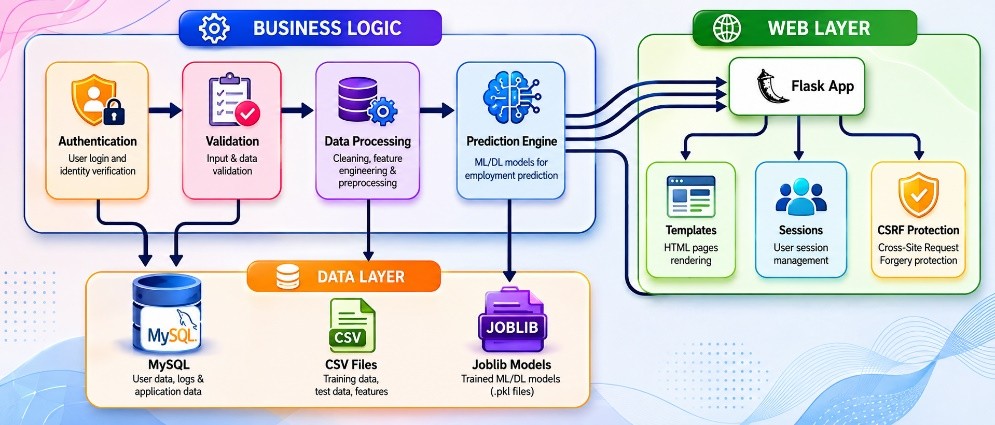
Block Diagram
Specifications
4.1 SOFTWARE REQUIREMENS
Operating System : Windows 7/8/10
Server side Script : HTML, CSS, Bootstrap & JS
Programming Language : Python
Libraries : Flask, Pandas, Sklearn, Numpy , Seaborn
IDE/Workbench : VSCODE
Server Deployment : Xampp Server
Database : MySQL
4.2 HARDWARE REQUIREMENTS
Processor - I3/Intel Processor
RAM - 8GB (min)
Hard Disk - 128 GB
Key Board - Standard Windows Keyboard
Mouse - Two or Three Button Mouse
Monitor - Any

Demo Video


Request for Video
 Paper Publishing
Request Call Back
Would you like to receive a free callback now?
Choose the best time for callback:
Leave your message and we will contact you as soon as possible

6-2-85/B, Old Maternity Hospital Road, Thyagaraja Nagar, Tirupati, Andhra Pradesh – 517501
+91 9030333433
+91 9393939065
0877-2261612

Disclaimer - Takeoff Edu Group Projects are not associated or affiliated with IEEE in any way. The IEEE Projects mentioned here are mentioned in the context of student projects, whose ideas are derived from IEEE publications, not projects of or by IEEE.

