Smart Fingerprint-Based Door Lock System with GSM Alert Using Raspberry Pi Pico
Objective
To design and implement a secure door access system using Raspberry Pi Pico and fingerprint authentication, ensuring only authorized users can unlock the door. Additionally, to enhance security by integrating a GSM module that sends real-time SMS alerts during unauthorized access attempts.
Abstract
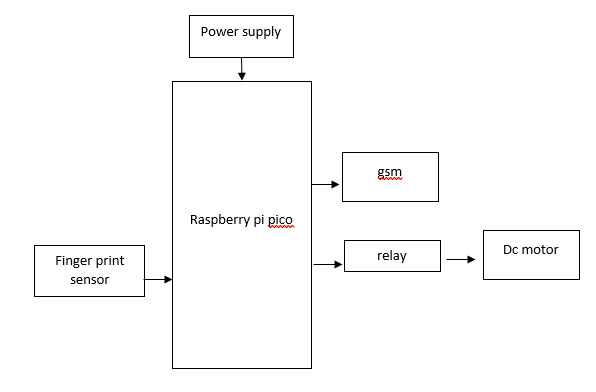
The Smart Fingerprint-Based Door Lock System with GSM Alert Using Raspberry Pi Pico is a secure and cost-effective solution designed for enhanced access control in homes and offices. It uses a Raspberry Pi Pico microcontroller to interface with an R307 fingerprint sensor that identifies and verifies authorized users through biometric authentication. When a valid fingerprint is detected, the system activates a relay module to drive a DC motor, which opens the door. In case of an unauthorized access attempt, a SIM800C GSM module sends an SMS alert to the registered mobile number, notifying the user of the security breach. This integration of fingerprint-based access with GSM alerting offers a reliable and real-time security mechanism, eliminating the risks associated with traditional locks and password-based systems.
NOTE: Without the concern of our team, please don't submit to the college. This Abstract varies based on student requirements.
Block Diagram
Specifications
Hardware Requirements
- Rasberry pi pico
- Relay
- r307 finger print system
- Powersupply
- GSM
Software Requirements
- Thonny
Learning Outcomes
- - Understanding Arduino architecture and pin configuration
- - Installing and setting up Arduino IDE for development
- - Writing and uploading Arduino programs for biometric authentication
- - Interfacing fingerprint sensors with Arduino for secure access control
- - Controlling DC motors using a motor driver for door automation
- - Implementing push buttons for manual authentication control
- - Displaying authentication status on an LCD screen
- - Understanding power supply requirements for biometric systems
- About Project Development Life Cycle:
- Planning and Requirement Gathering (software’s, Tools, Hardware components, etc.,)
- Schematic preparation
- Code development and debugging
- Hardware development and debugging
- Development of the Project and Output testing
- Practical exposure to:
- Hardware and software tools.
- Solution providing for real time problems.
- Working with team/ individual.
- Work on Creative ideas.
- Project development Skills
- Problem analyzing skills
- Problem solving skills
- Creativity and imaginary skills
- Programming skills
- Deployment
- Testing skills
- Debugging skills
- Project presentation skills
- Thesis writing skills


 Paper Publishing

Request Call Back
Would you like to receive a free callback now?
Choose the best time for callback:
Leave your message and we will contact you as soon as possible

6-2-85/B, Old Maternity Hospital Road, Thyagaraja Nagar, Tirupati, Andhra Pradesh – 517501
+91 9030333433
+91 9393939065
0877-2261612

Disclaimer - Takeoff Edu Group Projects are not associated or affiliated with IEEE in any way. The IEEE Projects mentioned here are mentioned in the context of student projects, whose ideas are derived from IEEE publications, not projects of or by IEEE.

