Smart Dog Health Tracker: An IoT and Machine Learning-Based Remote Monitoring System With Emotional Design Integration
Objective
To develop a smart dog health tracking system using IoT technology that continuously monitors vital parameters and activity levels, enabling real-time remote monitoring through a connected mobile or cloud platform To integrate machine learning–based analysis for early detection of potential health risks and incorporate emotional design features to enhance user engagement, pet-owner bonding, and overall user experience.
Abstract
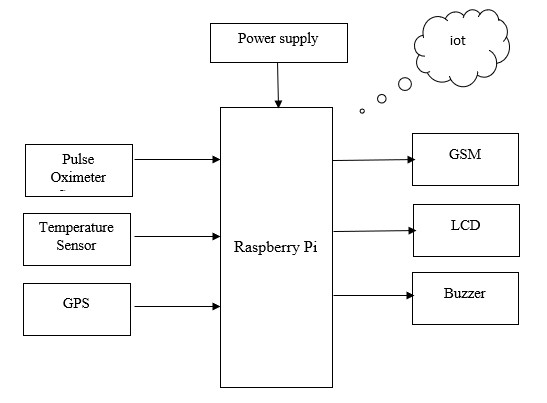
The Smart Dog Health Tracker: An IoT and Machine Learning-Based Remote Monitoring System with Emotional Design Integration is designed to monitor and analyze the health condition of dogs using an intelligent IoT-based monitoring system. The proposed system employs a pulse oximeter sensor to measure heart rate and oxygen saturation levels, along with a temperature sensor to monitor the body temperature of the dog. A Raspberry Pi functions as the main processing unit to collect physiological data and upload it to the ThingSpeak IoT cloud platform for remote access and data storage. Machine Learning techniques based on the Random Forest algorithm are applied to analyze the collected health parameters and predict possible abnormal health conditions. Whenever abnormal values are detected, a buzzer alert is activated and notification messages along with location information are sent to the pet owner or veterinarian through GSM and GPS modules. The system also incorporates emotional design integration to strengthen interaction between pets and owners by enabling timely health awareness and emergency alerts. This proposed solution enhances animal healthcare management through intelligent monitoring, cloud connectivity, and predictive analysis.
NOTE: Without the concern of our team, please don't submit to the college. This Abstract varies based on student requirements.
Block Diagram
Specifications
Hardware components:
· Raspberry Pi
· Memory Card
· Power Supply
· Adapter
· Pulse Oximeter Sensor
· Temperature Sensor
· LCD Display
· GSM Module
· GPS Module
· Buzzer
Software requirements:
· Raspbian OS
· Python
Learning Outcomes
Learning Outcomes
- Understanding Raspberry Pi architecture and pin configuration
- Installation and setup of Raspberry Pi OS
- Software installation and system configuration for Raspberry Pi
- Introduction to Raspberry Pi development environment
- Basic programming using Python for embedded applications
- Fundamentals of Embedded Systems programming
- Basics of IoT platforms and cloud connectivity
- Understanding power supply and hardware interfacing
- Knowledge of sensor interfacing with Raspberry Pi
Project Development Life Cycle
- Planning and Requirement Gathering (hardware, software, and tools)
- Circuit and schematic preparation
- Program development and debugging
- Hardware interfacing and troubleshooting
- System integration and output testing
Practical Exposure
- Working with hardware and software tools
- Developing solutions for practical monitoring systems
- Individual and team-based project implementation
- Implementation of innovative and creative ideas
Skills Developed
- Embedded system development
- Problem analysis
- Problem solving
- Programming skills
- Creativity and innovation
- System deployment
- Testing and validation
- Debugging techniques
- Project presentation
- Technical documentation and thesis writing


 Paper Publishing

Request Call Back
Would you like to receive a free callback now?
Choose the best time for callback:
Leave your message and we will contact you as soon as possible

6-2-85/B, Old Maternity Hospital Road, Thyagaraja Nagar, Tirupati, Andhra Pradesh – 517501
+91 9030333433
+91 9393939065
0877-2261612

Disclaimer - Takeoff Edu Group Projects are not associated or affiliated with IEEE in any way. The IEEE Projects mentioned here are mentioned in the context of student projects, whose ideas are derived from IEEE publications, not projects of or by IEEE.

