Smart Device for Blind
Abstract
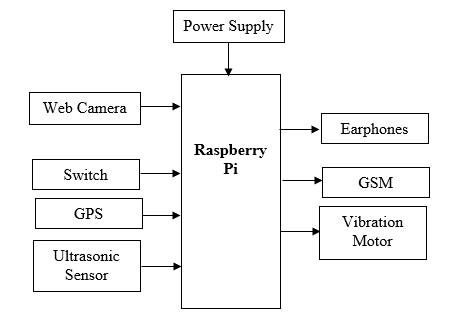
The Smart Device for blind represents potential aid for people who are visually impaired that might lead to improvements in the quality of life. The smart device is for the people who need to know what obstacle is there in front of them independently and feel socially convenient and secure while they do so. It is based on the simple idea that blind people do not want to stand out while using tools for help. This project focuses on the significant work done in the field of electronics and the features which comes as add-ons. This Smart device consists of ultrasonic sensor to detect the object ahead in real-time and feeds the Raspberry for analysis of the object distance. It can also assist the person on whether the object is closing in very fast and if so, provides a warning in the recognized direction.
Keywords: Raspberry Pi, Ultrasonic Sensor, Object Detection.
NOTE: Without the concern of our team, please don't submit to the college. This Abstract varies based on student requirements.
Block Diagram
Specifications
Hardware Requirements:
- Raspberry Pi
- Web Camera
- Ultrasonic Sensor
- GPS
- Switch
- Vibration Motor
- 5V Adapter
Software Requirements:
- NOOBS Software
- Python IDE
- Raspbian OS
Learning Outcomes
- Raspberry pi pin diagram and architecture
- How to install NOOBS software
- Setting up and installation procedure for Raspberry Pi
- How to connect Raspberry Pi through VNC viewer
- Introduction to Python3 IDE
- Commands in Python
- Basic coding in Python
- How to interface Web Camera with Raspberry Pi?
- Working of Ultrasonic Sensor
- How to interface Ultrasonic Sensor with Raspberry Pi?
- Working of GPS
- How to interface GPS with Raspberry Pi?
- Working of Vibration motor
- How to interface Vibration motor with Raspberry Pi?
- Working of GSM
- How to interface GSM with Raspberry Pi?
- Working of Switch
- How to interface Switch with Raspberry Pi?
- About Project Development Life Cycle:
- Planning and Requirement Gathering (software’s, Tools, Hardware components, etc.,)
- Schematic preparation
- Code development and debugging
- Hardware development and debugging
- Development of the Project and Output testing
- Practical exposure to:
- Hardware and software tools.
- Solution providing for real time problems.
- Working with team/ individual.
- Work on Creative ideas.
- Project development Skills
- Problem analyzing skills
- Problem solving skills
- Creativity and imaginary skills
- Programming skills
- Deployment
- Testing skills
- Debugging skills
- Project presentation skills
- Thesis writing skills


 Paper Publishing

Request Call Back
Would you like to receive a free callback now?
Choose the best time for callback:
Leave your message and we will contact you as soon as possible

6-2-85/B, Old Maternity Hospital Road, Thyagaraja Nagar, Tirupati, Andhra Pradesh – 517501
+91 9030333433
+91 9393939065
0877-2261612

Disclaimer - Takeoff Edu Group Projects are not associated or affiliated with IEEE in any way. The IEEE Projects mentioned here are mentioned in the context of student projects, whose ideas are derived from IEEE publications, not projects of or by IEEE.

