Small-signal modeling and stability analysis of autonomous direct current microgrid with distributed energy storage system
Objective
The main objective of this project is small-signal modeling and stability analysis of an autonomous direct current (DC) microgrid with distributed energy storage system (DESS) is to investigate the dynamic behavior of the microgrid under small disturbances or variations in operating conditions.
Abstract
In this project the small-signal modeling and stability analysis of an autonomous direct current (DC) microgrid with a distributed energy storage system (DESS) is crucial for the successful implementation of the project. The DC microgrid comprises renewable energy sources, such as photovoltaic (PV) panels, wind turbines, and batteries, and loads, such as lighting and appliances. The DESS includes batteries and supercapacitor that store and release energy to maintain the stability of the microgrid. To analyze the stability of the system, a small-signal model is developed using linearized equations that represent the system's behavior around the equilibrium point. The model includes the dynamics of the PV panels, wind turbines, batteries, supercapacitor, loads, and the DC-DC converters that interface these components. The small-signal analysis involves calculating the system's transfer functions, eigenvalues, and eigenvectors to assess the system's stability and response to disturbances. The stability analysis is critical to ensure that the system remains stable under different operating conditions, such as changes in load demand or renewable energy availability. The analysis also helps in designing the control system to maintain the system's stability and mitigate potential instabilities, such as voltage and frequency oscillations. Overall, the small-signal modeling and stability analysis of an autonomous DC microgrid with a DESS are crucial for designing, operating, and controlling the system. The analysis provides insights into the system's behavior and helps in developing control strategies that ensure the system's stability and reliability.by using matalb/simulink software
Keywords: solar, fuel cell supercapacitor, mppt algorithm, distributed storage system
NOTE: Without the concern of our team, please don't submit to the college. This Abstract varies based on student requirements.
Block Diagram
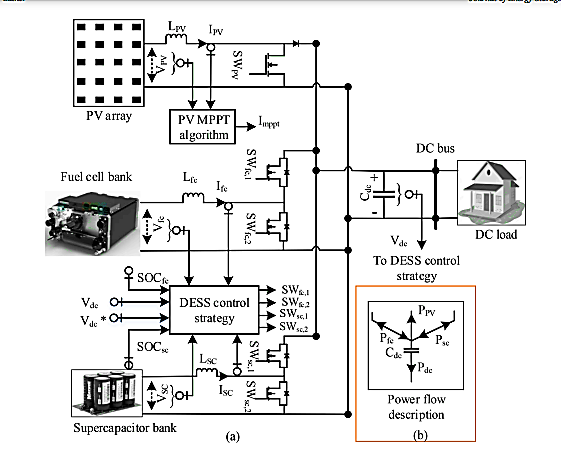
Specifications
Software Configuration:
Operating System : Windows 7/8/10
Application Software : Matlab/Simulink
Hardware Configuration:
RAM : 8 GB
Processor : I3 / I5(Mostly prefer)
Learning Outcomes
· Introduction to Matlab/Simulink
· What is EISPACK & LINPACK
· How to start with MATLAB
· About Matlab language
· About tools & libraries
· Application of Matlab/Simulink
· About Matlab desktop
· Features of Matlab/Simulink
· Basics on Matlab/Simulink
· We can learn about fuel cell
· We can learn about solar pv array
· We can learn about mppt techniques
· Project Development Skills:
o Problem analyzing skills
o Problem solving skills
o Creativity and imaginary skills
o Programming skills
o Deployment
o Testing skills
o Debugging skills
o Project presentation skills
Demo Video


Request for Video
 Paper Publishing
Request Call Back
Would you like to receive a free callback now?
Choose the best time for callback:
Leave your message and we will contact you as soon as possible

6-2-85/B, Old Maternity Hospital Road, Thyagaraja Nagar, Tirupati, Andhra Pradesh – 517501
+91 9030333433
+91 9393939065
0877-2261612

Disclaimer - Takeoff Edu Group Projects are not associated or affiliated with IEEE in any way. The IEEE Projects mentioned here are mentioned in the context of student projects, whose ideas are derived from IEEE publications, not projects of or by IEEE.

