Single Underwater Image Restoration Using Variational Framework Guided by Imaging Model with Noise
Objective
The objective is to enhance underwater image quality by integrating an improved imaging model with noise and variational frameworks for superior contrast, color correction, and noise suppression.
Abstract
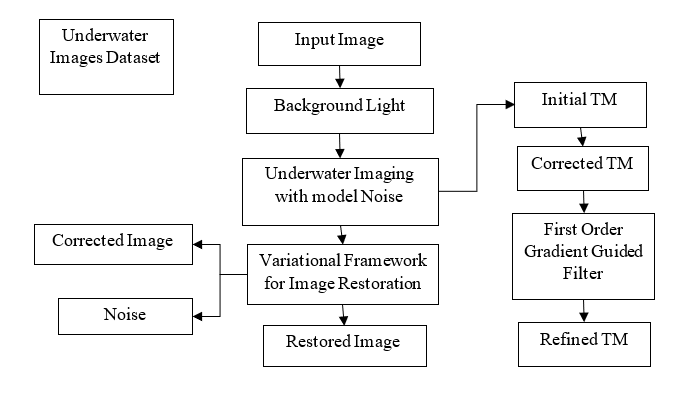
This project presents an effective method for underwater image restoration by addressing the common challenges of distortion and noise in underwater environments. The proposed approach includes three main stages: background light estimation, transmission map calculation, and image restoration using a variational framework. Initially, background light is estimated by identifying the brightest pixels from the dark channel, which represent the scene's background illumination. This step is crucial for enhancing the contrast of submerged images. Following this, a transmission map is calculated using a simplified dark channel prior to model the haze effect in underwater scenes. To refine the initial transmission map, a first-order guided filter is applied, resulting in a more accurate representation of image depth and object visibility. Noise simulation is introduced to mimic real-world underwater noise, with noise removal performed using median filtering for improved clarity. Finally, the restored image is generated using a variational framework based on the transmission map and background light. The result is a clear, visually enhanced image that mitigates haze and noise while improving feature visibility. This method can be particularly useful for underwater imaging applications such as marine biology, underwater exploration, and underwater robotics. The implementation is carried out in MATLAB, leveraging its image processing capabilities.
Keywords: Underwater Images Dataset, Pre-Processing, Image Processing Techniques and Enhancement.
NOTE: Without the concern of our team, please don't submit to the college. This Abstract varies based on student requirements.
Block Diagram
Specifications
Software: Matlab 2020a or above
Hardware:
Operating Systems:
- Windows 10
- Windows 7 Service Pack 1
- Windows Server 2019
- Windows Server 2016
Processors:
Minimum: Any Intel or AMD x86-64 processor
Recommended: Any Intel or AMD x86-64 processor with four logical cores and AVX2 instruction set support
Disk:
Minimum: 2.9 GB of HDD space for MATLAB only, 5-8 GB for a typical installation
Recommended: An SSD is recommended A full installation of all MathWorks products may take up to 29 GB of disk space
RAM:
Minimum: 4 GB
Recommended: 8 GB
Learning Outcomes
· Introduction to Matlab
· What is EISPACK & LINPACK
· How to start with MATLAB
· About Matlab language
· Matlab coding skills
· About tools & libraries
· Application Program Interface in Matlab
· About Matlab desktop
· How to use Matlab editor to create M-Files
· Features of Matlab
· Basics on Matlab
· What is an Image/pixel?
· About image formats
· Introduction to Image Processing
· How digital image is formed
· Importing the image via image acquisition tools
· Analyzing and manipulation of image.
· Phases of image processing:
o Acquisition
o Image enhancement
o Image restoration
o Color image processing
o Image compression
o Morphological processing
o Segmentation etc.,
· How to extend our work to another real time applications
· Project development Skills
o Problem analyzing skills
o Problem solving skills
o Creativity and imaginary skills
o Programming skills
o Deployment
o Testing skills
o Debugging skills
o Project presentation skills
o Thesis writing skills
Demo Video


Request for Video
 Paper Publishing
Request Call Back
Would you like to receive a free callback now?
Choose the best time for callback:
Leave your message and we will contact you as soon as possible

6-2-85/B, Old Maternity Hospital Road, Thyagaraja Nagar, Tirupati, Andhra Pradesh – 517501
+91 9030333433
+91 9393939065
0877-2261612

Disclaimer - Takeoff Edu Group Projects are not associated or affiliated with IEEE in any way. The IEEE Projects mentioned here are mentioned in the context of student projects, whose ideas are derived from IEEE publications, not projects of or by IEEE.

