Simple Yet Powerful Machine Learning Based IoT Intrusion System With Smart Preprocessing and Feature Generation Rivals Deep Learning
Objective
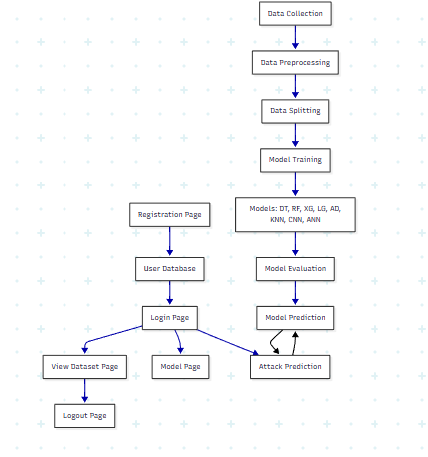
This project develops an IoT intrusion detection system using machine learning to identify attacks within IoT networks. Leveraging the UNSW-NB15 dataset, the system classifies attacks like DoS, Exploits, and Worms. It applies models such as Decision Tree, Random Forest, XGBoost, LightGBM, AdaBoost, ANN, and CNN for attack classification. Advanced preprocessing enhances model accuracy. The system's backend handles model training, while the frontend, built with Flask, offers an intuitive interface for attack predictions.
Abstract
This project focuses on building an IoT intrusion detection system using machine learning to identify various attack types within IoT networks. It leverages the UNSW-NB15 dataset to classify attacks into eight categories: DoS, Exploits, Fuzzers, Generic, Normal, Reconnaissance, Shellcode, and Worms. The system applies several machine learning models, including Decision Tree (DT), Random Forest (RF), XGBoost, LightGBM, AdaBoost, Artificial Neural Networks (ANN), and Convolutional Neural Networks (CNN) for attack classification. These models are trained and evaluated to predict the nature of incoming attacks based on network traffic features. The system incorporates advanced preprocessing techniques to enhance the accuracy of the models by generating relevant features from the dataset. The backend is responsible for model training and prediction, while the frontend, developed using Flask, HTML, CSS, and JavaScript, provides a user-friendly interface. Users can register, log in, and input data to predict attack types, offering an effective solution for IoT network security management.
Keywords: IoT Intrusion Detection, Machine Learning, UNSW-NB15 Dataset, Attack Classification, DoS, Exploits, Fuzzers, Generic, Normal, Reconnaissance, Shellcode, Worms, Decision Tree, Random Forest, XGBoost, LightGBM, AdaBoost, Artificial Neural Networks, Convolutional Neural Networks, Feature Preprocessing, Flask, Web Application, Frontend Development, Backend Development, IoT Network Security.
NOTE: Without the concern of our team, please don't submit to the college. This Abstract varies based on student requirements.
Block Diagram
Specifications
SOFTWARE REQUIREMENS
Operating System : Windows 7/8/10
Server-side Script : HTML, CSS, Bootstrap & JS
Programming Language : Python
Libraries : Flask, Pandas,, Sklearn,Tensorflow,NumPy, Seaborn, Matplotlib
IDE/Workbench : VSCode
Technology : Python 3.8+
Server Deployment : Xampp Server
Database : MySQL
HARDWARE REQUIREMENTS
Processor - I5/Intel Processor
RAM - 8GB+ (min)
Hard Disk - 128 GB+
Key Board - Standard Windows Keyboard
Mouse - Two or Three Button Mouse
Monitor - Any


 Paper Publishing

Request Call Back
Would you like to receive a free callback now?
Choose the best time for callback:
Leave your message and we will contact you as soon as possible

6-2-85/B, Old Maternity Hospital Road, Thyagaraja Nagar, Tirupati, Andhra Pradesh – 517501
+91 9030333433
+91 9393939065
0877-2261612

Disclaimer - Takeoff Edu Group Projects are not associated or affiliated with IEEE in any way. The IEEE Projects mentioned here are mentioned in the context of student projects, whose ideas are derived from IEEE publications, not projects of or by IEEE.

