SHRED: An Ensemble-Based Machine Learning Model to Sift Email Messages for Real-Time Spam Detection
Objective
This project aims to develop a robust and efficient system that can classify emails as spam or not based on their content and metadata. The rapid increase in the volume of email communication has made it essential for email service providers to integrate spam detection systems that can automatically filter unwanted messages. Traditional methods of spam detection, such as rule-based filtering, have become ineffective due to the complexity and diversity of spam messages. To address this, SHRED utilizes an ensemble learning approach, combining multiple models like Convolutional Neural Networks (CNN), XGBoost, HybridBoost, and StreamSHRED – Online Incremental Ensemble. The ensemble method is designed to enhance the system's accuracy by integrating the strengths of various algorithms, enabling it to effectively differentiate between spam and non-spam messages.
Abstract
This project aims to develop a robust and efficient system that can classify emails as spam or not based on their content and metadata. The rapid increase in the volume of email communication has made it essential for email service providers to integrate spam detection systems that can automatically filter unwanted messages. Traditional methods of spam detection, such as rule-based filtering, have become ineffective due to the complexity and diversity of spam messages. To address this, SHRED utilizes an ensemble learning approach, combining multiple models like Convolutional Neural Networks (CNN), XGBoost, HybridBoost, and StreamSHRED – Online Incremental Ensemble. The ensemble method is designed to enhance the system's accuracy by integrating the strengths of various algorithms, enabling it to effectively differentiate between spam and non-spam messages. The system also incorporates an online incremental learning mechanism via StreamSHRED, which allows the model to continuously learn from new data without requiring retraining on the entire dataset. This is particularly useful in an evolving environment where spam tactics change rapidly. The dataset used for training consists of email metadata, such as sender, recipient, and subject, as well as the content of the message. The system preprocesses this data, extracts relevant features, and then applies machine learning models for classification. The overall objective is to develop a system that ensures high accuracy, reduced false positives, and enhanced user satisfaction. The web-based interface allows users to input email messages and receive real-time predictions, making it a user-friendly tool for email services. The system is trained to predict the likelihood of an email being spam based on its content, which can be further used to block or categorize emails accordingly.
Keywords: Email Classification, Spam Detection, Ensemble Learning, XGBoost, CNN, HybridBoost, StreamSHRED, Online Incremental Learning, Feature Extraction, Real-time Prediction.
NOTE: Without the concern of our team, please don't submit to the college. This Abstract varies based on student requirements.
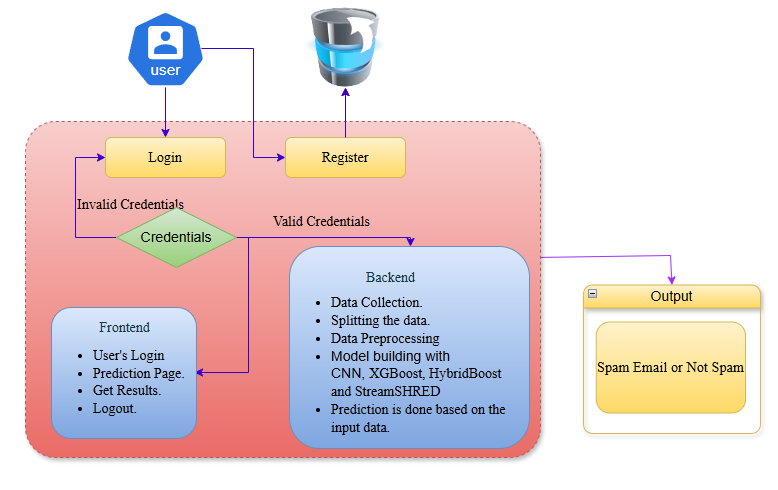
Block Diagram
Specifications
HARDWARE REQUIREMENTS
• Processor - I5/Intel Processor
• RAM - 8GB (min)
• Hard Disk - 160 GB
• Key Board - Standard Windows Keyboard
• Mouse - Two or Three Button Mouse
• Monitor - Any
SOFTWARE REQUIREMENS
• Operating System : Windows 7/8/10
• Server side Script : HTML, CSS, Bootstrap & JS
• Programming Language : Python
• Libraries : Flask, Pandas, Mysql.connector, Os, Numpy,
Scikit-learn.
• IDE/Workbench : VS-Code
• Technology : Python 3.10+
• Server Deployment : Xampp Server
• Database : MySQL

Demo Video


Request for Video
 Paper Publishing
Request Call Back
Would you like to receive a free callback now?
Choose the best time for callback:
Leave your message and we will contact you as soon as possible

6-2-85/B, Old Maternity Hospital Road, Thyagaraja Nagar, Tirupati, Andhra Pradesh – 517501
+91 9030333433
+91 9393939065
0877-2261612

Disclaimer - Takeoff Edu Group Projects are not associated or affiliated with IEEE in any way. The IEEE Projects mentioned here are mentioned in the context of student projects, whose ideas are derived from IEEE publications, not projects of or by IEEE.

