self-adaptive traffic anomaly detection system for I to T smart home environment
Objective
A major objective is to design such a system that allows for unattended traffic adaptation in the smart home environment. In this manner, combining a Stacking Classifier, which utilizes multiple individual classifiers such as Random Forest, allows the detection of several anomaly types, thus boosting the classifier performance on the basis of ensemble learning. This helps the system generalize well to unseen data, hence a stronger detection environment for both known and novel threats.
Abstract
Within Internet of Things (IoT) smart homes, protection of network data streams against unauthorized access and anomalies is vital. This paper proposes an embedded Self-Adaptive Traffic Anomaly Detection Systems (SATADS) in IoT smart homes. The system relies on effective detection and mitigation of traffic anomalies with respect to IoT smart home networks. It has built into it the characteristics of machine learning techniques, supplemented with a Stacking Classifier model to increase the accuracy of anomaly detection, which avails itself of numerous individual classifiers like Random Forest to evaluate characteristics' importance and thereby enhance performance predictively in addition. especially the system is provided with Explainable AI (XAI) techniques to maintain open-ness of the anomaly-detection process for end-users in terms of actionable information for easy understanding and usability. The performance evaluation was conducted using field data (invade.csv) intended for simulating IoT network traffic with useful results showing acceptable performance, mainly in detecting familiar as well as new traffic anomalies. These contributions by the proposed SATADS include self-adaptive, transparent, and trustworthy anomaly detection systems for smart home scenarios that secure the safety and soundness of IoT networks.
Keywords: IoT, Smart Home Environments, Traffic Anomaly Detection, Self-Adaptive Systems, Stacking Classifier, Random Forest, Feature Importance, Explainable AI (XAI), Machine Learning, Cybersecurity, Anomaly Detection System, IoT Security, Transparent AI, Predictive Modeling.
NOTE: Without the concern of our team, please don't submit to the college. This Abstract varies based on student requirements.
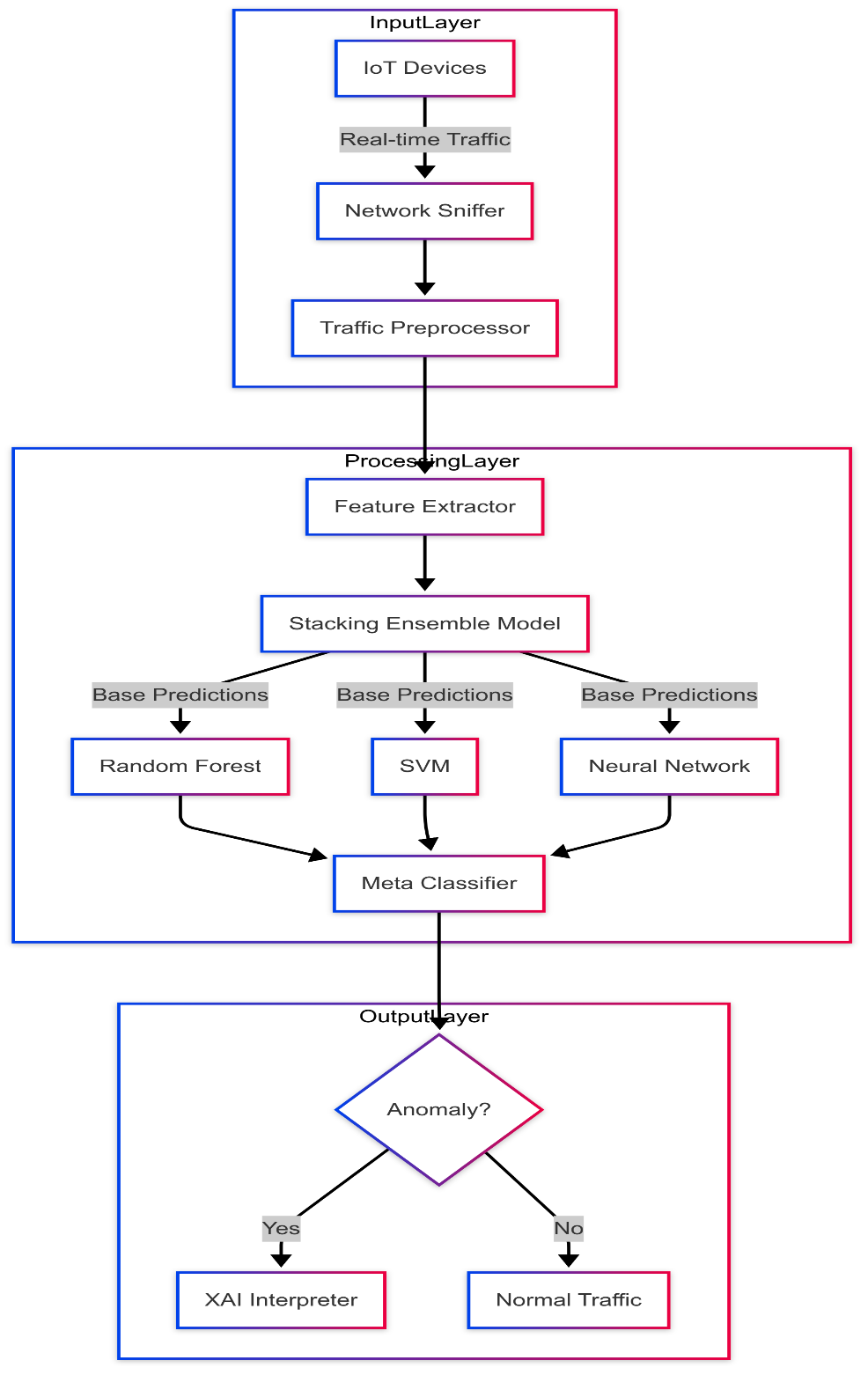
Block Diagram
Specifications
4.1 SOFTWARE REQUIREMENS
Operating System : Windows 7/8/10
Server side Script : HTML, CSS, Bootstrap & JS
Programming Language : Python
Libraries :Flask, Torch, Tensorflow, Pandas, Mysql.connector
IDE/Workbench : VSCode
Server Deployment : Xampp Server
Database : MySQL
4.2 HARDWARE REQUIREMENTS
Processor - I3/Intel Processor
RAM - 8GB (min)
Hard Disk - 128 GB
Key Board - Standard Windows Keyboard
Mouse - Two or Three Button Mouse
Monitor - Any


 Paper Publishing

Request Call Back
Would you like to receive a free callback now?
Choose the best time for callback:
Leave your message and we will contact you as soon as possible

6-2-85/B, Old Maternity Hospital Road, Thyagaraja Nagar, Tirupati, Andhra Pradesh – 517501
+91 9030333433
+91 9393939065
0877-2261612

Disclaimer - Takeoff Edu Group Projects are not associated or affiliated with IEEE in any way. The IEEE Projects mentioned here are mentioned in the context of student projects, whose ideas are derived from IEEE publications, not projects of or by IEEE.

