Secure Quantum Communication With Multi-Users in Quantum Networks
Objective
The primary objective of this project is to develop a secure multi-user quantum communication framework by integrating Quantum Key Distribution (QKD) with encryption protocols, ensuring secure and efficient communication within quantum networks. The framework aims to enhance communication efficiency and scalability by leveraging classical-quantum multiple access techniques, thereby improving speed and resource utilization across multiple users. Additionally, the project seeks to implement advanced security protocols, such as the Multi-User Quantum Protocol (MUQPQ) and MUQQ-ESTMP GHZ protocols, to prevent unauthorized access and eavesdropping, thus ensuring a robust defense against security vulnerabilities. A key focus is on protecting against quantum computing attacks through the integration of lattice-based cryptography. The project also aims to deploy the Reverse Reconciliation Algorithm for Binary-Input Additive White Gaussian Noise Channel (RRA-BIAWGNC) for effective eavesdropping detection in real-time
Abstract
This project presents a secure multi-user communication framework for quantum networks, focusing on the integration of Quantum Key Distribution (QKD) and encryption protocols for protecting user-to-user communication. The system is designed to address the challenges of eavesdropping detection, security vulnerabilities, and performance issues caused by high traffic levels in quantum communication networks. The framework incorporates classical-quantum multiple access techniques to enhance speed and scalability, while optimizing security through the Multi-User Quantum Protocol (MUQPQ) and the MUQQ-ESTMP GHZ protocol. Lattice-based cryptography is employed to safeguard against quantum computing threats, and the Reverse Reconciliation Algorithm for Binary-Input Additive White Gaussian Noise Channel (RRA-BIAWGNC) is used for eavesdropping detection. Additionally, the system integrates QPQB as a searchable symmetric encryption protocol for securing cloud-based file storage.
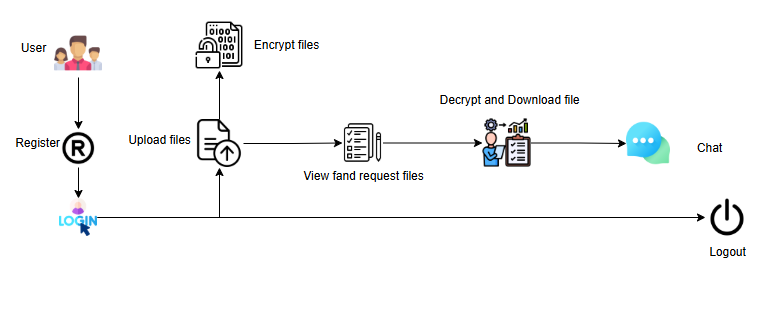
The user-centric model of the system allows for user registration, login, file uploads, and requests, secure communication through chat, and decryption of files, all within a robust security framework. Performance analysis indicates a significant reduction in communication complexity (up to 40%) and a substantial improvement in eavesdropper detection accuracy (97%), with key metrics such as communication efficiency (96%) and effective key rate (590 b/s). Simulations, conducted with ns-3.30.1 and Python, show that the system surpasses current benchmarks in terms of performance, making it a significant advancement in scalable, secure quantum communication networks.
Keywords: Quantum Key Distribution (QKD), quantum networks, multi-user communication, encryption protocols, secure communication, eavesdropping detection, classical-quantum multiple access, Multi-User Quantum Protocol (MUQPQ), MUQQ-ESTMP GHZ protocol, lattice-based cryptography, quantum computing security, Reverse Reconciliation Algorithm (RRA-BIAWGNC), searchable symmetric encryption (PQPB), file upload and decryption, cloud storage security, communication complexity, effective key rate, communication efficiency, computational overhead, quantum protocols integration, ns-3.30.1 simulation, and quantum communication scalability.
NOTE: Without the concern of our team, please don't submit to the college. This Abstract varies based on student requirements.
Block Diagram
Specifications
H/W CONFIGURATION:
Processor - I3/Intel Processor
Hard Disk - 160GB
Key Board - Standard Windows Keyboard
Mouse - Two or Three Button Mouse
Monitor - SVGA
RAM - 8GB
S/W CONFIGURATION:
Operating System : Windows 7/8/10
Server side Script : HTML, CSS, Bootstrap & JS
Programming Language : Python
Libraries : Django
IDE/Workbench : VSCODE
Technology : Python 3.10+


 Paper Publishing

Request Call Back
Would you like to receive a free callback now?
Choose the best time for callback:
Leave your message and we will contact you as soon as possible

6-2-85/B, Old Maternity Hospital Road, Thyagaraja Nagar, Tirupati, Andhra Pradesh – 517501
+91 9030333433
+91 9393939065
0877-2261612

Disclaimer - Takeoff Edu Group Projects are not associated or affiliated with IEEE in any way. The IEEE Projects mentioned here are mentioned in the context of student projects, whose ideas are derived from IEEE publications, not projects of or by IEEE.

