Secure and Efficient Online Fingerprint Authentication Scheme Based on Cloud Computing
Objective
We propose the Secure e-finger scheme for biometric-based online fingerprint authentication, enhancing privacy protection against temporary fingerprint attacks while maintaining efficiency. Additionally, we introduce a threshold scheme based on biological characteristics to address excessive authority issues, ensuring secure and robust authentication.
Abstract
The e-Finga online fingerprint authentication system, while efficient, is vulnerable to privacy breaches due to its use of deterministic encryption. Researchers found that adversaries could potentially exploit this to steal fingerprint data. To enhance security, the Secure e-finger scheme was introduced, employing a more complex encryption method that still allows for quick computations and minimal communication overhead. This upgrade increases the client's running time slightly by 6% but offers a substantial improvement in privacy protection, effectively blocking the identified attack without sacrificing performance. Additionally, a threshold scheme is suggested to prevent excessive access rights for single users.
NOTE: Without the concern of our team, please don't submit to the college. This Abstract varies based on student requirements.
Block Diagram
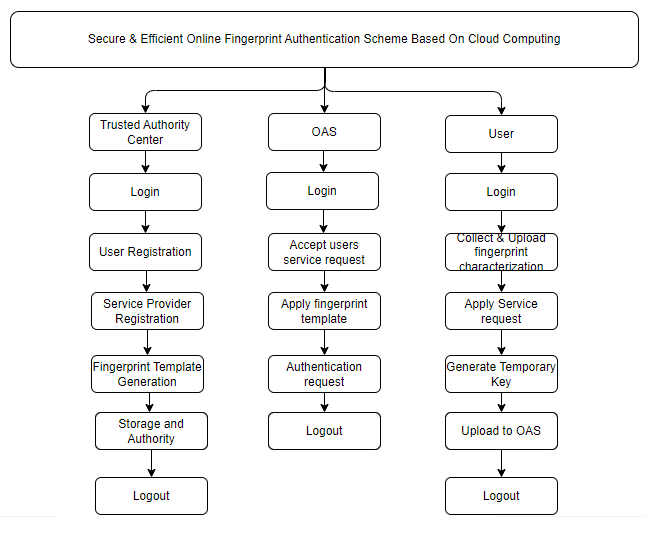
Specifications
H/W CONFIGURATION:
Processor - I3/Intel Processor
Hard Disk - 160GB
Key Board - Standard Windows Keyboard
Mouse - Two or Three Button Mouse
Monitor - SVGA
RAM - 8GB
S/W CONFIGURATION:
• Operating System : Windows 7/8/10
• Server side Script : HTML, CSS, Bootstrap & JS
• Programming Language : Python
• Libraries : Django, Pandas, Mysql.connector, Os, Smtplib, Numpy
• IDE/Workbench : PyCharm
• Technology : Python 3.6+
• Server Deployment : Xampp Server


 Paper Publishing

Request Call Back
Would you like to receive a free callback now?
Choose the best time for callback:
Leave your message and we will contact you as soon as possible

6-2-85/B, Old Maternity Hospital Road, Thyagaraja Nagar, Tirupati, Andhra Pradesh – 517501
+91 9030333433
+91 9393939065
0877-2261612

Disclaimer - Takeoff Edu Group Projects are not associated or affiliated with IEEE in any way. The IEEE Projects mentioned here are mentioned in the context of student projects, whose ideas are derived from IEEE publications, not projects of or by IEEE.

