scaleTRIM: Scalable TRuncation-Based Integer Approximate Multiplier with Linearization and Compensation
Objective
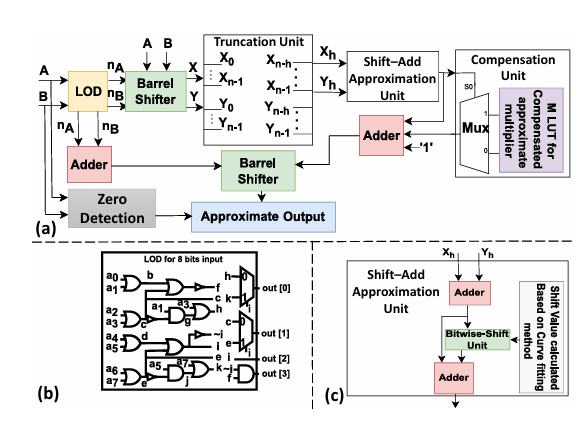
In this paper, we propose a scalable approximate multiplier design, scaleTRIM, that approximates the multiplication operation using fitted linear functions, also referred to as linearization. We show that multiplication operations can be completely replaced by low-cost addition and bit-wise shift operations by exploiting linearization. Moreover, our proposed design utilizes a lookup table (LUT) based compensation unit as a novel error-reduction method. In essence, input operands are truncated to a reduced bit-width representation (i.e., h bits) based on their leading-one positions. Then, a curve fitting method is employed to map the product term to a linear function. Additionally, a piecewise constant error-correction term is used to reduce the approximation error. To compute the piecewise constant, we divide the function space into M segments and average the errors within each segment.
Abstract
we propose a scalable approximate multiplier design, scaleTRIM, that approximates the multiplication operation using fitted linear functions, also referred to as linearization. We show that multiplication operations can be completely replaced by low-cost addition and bit-wise shift operations by exploiting linearization. Moreover, our proposed design utilizes a lookup table (LUT)-based compensation unit as a novel error-reduction method. In essence, input operands are truncated to a reduced bit-width representation (i.e., h bits) based on their leading-one positions. Then, a curve-fitting method is employed to map the product term to a linear function. Additionally, a piecewise constant error-correction term is used to reduce the approximation error. To compute the piecewise constant, we divide the function space into M segments and average the errors within each segment. In particular, our multiplier supports various degrees of truncation and error compensation to offer a range of accuracy-efficiency trade-offs. The proposed multiplier improves the Mean Relative Error Distance (MRED) by about 15.2% while satisfying the efficiency constraint and improves the Power Delay Product (PDP) by about 22.8% while satisfying the accuracy and efficiency constraints compared to different state-of-the-art approximate multipliers. From a usability perspective, our evaluation of the proposed design for image classification using Deep Neural Networks (DNNs) demonstrates that scaleTRIM offers a better accuracy-efficiency trade-off than state-of the-art approximate multiplier designs.
NOTE: Without the concern of our team, please don't submit to the college. This Abstract varies based on student requirements.
Block Diagram
Specifications
Software Requirements
FPGA Design Tools
· Xilinx Vivado Design Suite (2023.2 or later)
· Vivado Synthesis
· Vivado Implementation
· Vivado Simulator
Hardware Description Language
· Verilog HDL
Learning Outcomes
· Design and implement a scalable truncation-based approximate multiplier using Verilog HDL.
· Understand the principles of approximate computing and hardware optimization.
· Implement leading-one detection, operand truncation, and linearization techniques.
· Design LUT-based error compensation mechanisms for reducing approximation errors.
· Perform FPGA synthesis and analyze area, power, delay, and Power-Delay Product (PDP).
· Compare the proposed architecture with conventional approximate multipliers using hardware performance metrics.
· Gain practical experience in FPGA-based low-power VLSI design for edge AI and DNN accelerator applications.
· Develop skills in configurable arithmetic circuit design suitable for energy-efficient embedded systems.


 Paper Publishing

Request Call Back
Would you like to receive a free callback now?
Choose the best time for callback:
Leave your message and we will contact you as soon as possible

6-2-85/B, Old Maternity Hospital Road, Thyagaraja Nagar, Tirupati, Andhra Pradesh – 517501
+91 9030333433
+91 9393939065
0877-2261612

Disclaimer - Takeoff Edu Group Projects are not associated or affiliated with IEEE in any way. The IEEE Projects mentioned here are mentioned in the context of student projects, whose ideas are derived from IEEE publications, not projects of or by IEEE.

