Sapota Ripeness Detection and Shelf Life Prediction Using Thermal
Objective
The primary objective of this project is to develop a robust system for sapota fruit quality assessment, focusing on ripeness detection, shelf-life prediction, and bruising classification. By leveraging thermal imaging technology, the aim is to create a non-destructive method capable of accurately distinguishing between rotten and not rotten sapota fruits, thereby facilitating timely quality control measures. Furthermore, the project aims to predict the shelf life of sapota fruits based on their ripeness status, enabling producers and distributors to optimize inventory management and minimize food waste. Additionally, the objective includes the classification of bruises on sapota fruits to identify potential damage and ensure only high-quality produce reaches the market. Through the integration of various deep learning models such as CNNs, including MobileNet, ResNet, and VGG16, the project seeks to achieve high accuracy and efficiency in sapota fruit quality assessment, ultimately contributing to enhanced consumer satisfaction and reduced food loss throughout the supply chain.
Abstract
Sapota, a tropical fruit, undergoes significant changes in ripeness and quality over time, impacting its shelf life and consumer appeal. This project explores the application of thermal imaging for sapota ripeness detection and shelf-life prediction, along with bruising classification. The dataset comprises images categorized into rotten and not rotten classes, accompanied by the number of days since the image was captured. Additionally, another dataset includes labels indicating bruises or no bruises on the fruit. Various convolutional neural network (CNN) architectures such as MobileNet, ResNet, and VGG16 are employed for both tasks. The effectiveness of each model is evaluated for sapota ripeness classification and shelf-life prediction, as well as bruising detection. Results indicate the potential of thermal imaging coupled with deep learning techniques for non-destructive quality assessment of sapota fruit, aiding in reducing food waste and enhancing consumer satisfaction.
Keywords: Sapota, thermal imaging, ripeness detection, shelf-life prediction, bruising classification, convolutional neural networks (CNNs), MobileNet, ResNet, VGG16, fruit quality assessment, food waste reduction
NOTE: Without the concern of our team, please don't submit to the college. This Abstract varies based on student requirements.
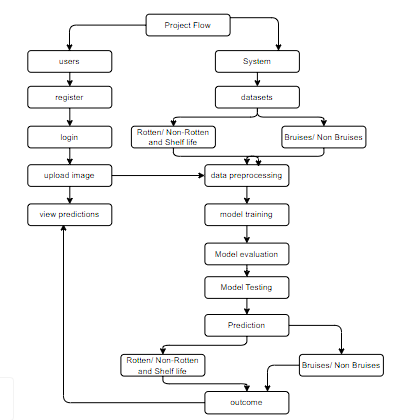
Block Diagram
Specifications
SOFTWARE REQUIREMENS
Operating System : Windows 7/8/10
Server side Script : HTML, CSS, Bootstrap & JS
Programming Language : Python
Libraries : Flask, Pandas, Torch, Keras, Sklearn, Numpy , Seaborn
IDE/Workbench : VSCode
Technology : Python 3.6+
Server Deployment : Xampp Server
Database : MySQL
HARDWARE REQUIREMENTS
Processor - I3/Intel Processor
RAM - 8GB (min)
Hard Disk - 128 GB
Key Board - Standard Windows Keyboard
Mouse - Two or Three Button Mouse
Monitor - Any

Demo Video


Request for Video
 Paper Publishing
Request Call Back
Would you like to receive a free callback now?
Choose the best time for callback:
Leave your message and we will contact you as soon as possible

6-2-85/B, Old Maternity Hospital Road, Thyagaraja Nagar, Tirupati, Andhra Pradesh – 517501
+91 9030333433
+91 9393939065
0877-2261612

Disclaimer - Takeoff Edu Group Projects are not associated or affiliated with IEEE in any way. The IEEE Projects mentioned here are mentioned in the context of student projects, whose ideas are derived from IEEE publications, not projects of or by IEEE.

