Safeguarding Journeys: Raspberry pi’s Intelligent Driver Monitoring
Objective
This project develops an intelligent driver monitoring system using Raspberry Pi to enhance road safety by tracking driver behavior and detecting fatigue or distraction, offering real-time alerts to promote safer driving.
Abstract
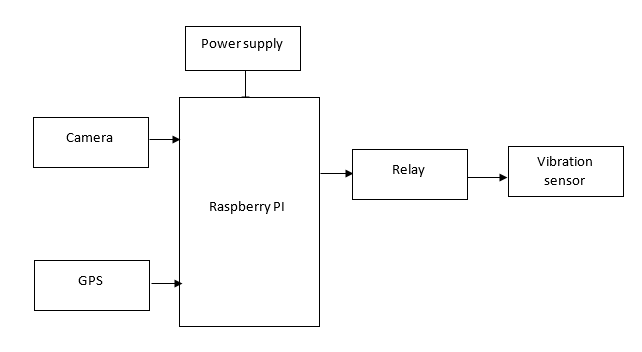
The Intelligent Driver Monitoring System using Raspberry Pi is designed to enhance road safety by monitoring the driver's alertness and detecting signs of drowsiness or fatigue. The system incorporates a Raspberry Pi, camera module, MEMS sensor, vibration motor, and relay to create a comprehensive solution. The camera continuously captures the driver's face and uses facial recognition algorithms to assess signs of drowsiness. If the system detects that the driver has fallen asleep or is exhibiting signs of fatigue, the vibration motor activates to alert the driver and prevent potential accidents. Additionally, the MEMS sensor monitors the driver's movements, detecting any abnormal behavior, such as falling or sudden head tilts, which could indicate loss of consciousness. If any unusual movement is detected, the system can trigger an alarm or activate the relay to stop the vehicle, ensuring the driver's safety. This integrated system leverages real-time monitoring and intelligent alert mechanisms to prevent road accidents due to driver drowsiness or inattention, making it a crucial tool for improving driving safety.
NOTE: Without the concern of our team, please don't submit to the college. This Abstract varies based on student requirements.
Block Diagram
Specifications
- - Raspberry Pi
- - Camera Module
- - Relay Module
- - MEMS Sensor
- - Vibration Motor
- - Power Supply
Learning Outcomes
- - Raspberry Pi pin diagram and architecture
- - Setting up and installation procedure for Raspberry Pi
- - Introduction to Raspberry Pi IDE and software tools
- - Basic coding with Raspberry Pi
- - Integration of Raspberry Pi with Sensors and Cameras
- - Facial Recognition Algorithms
- - Movement Detection and MEMS Sensor Usage
- - Programming and System Integration
- Working of power supply
- About Project Development Life Cycle:
- Planning and Requirement Gathering (software’s, Tools, Hardware components, etc.,)
- Schematic preparation
- Code development and debugging
- Hardware development and debugging
- Development of the Project and Output testing
- Practical exposure to:
- Hardware and software tools.
- Solution providing for real time problems.
- Working with team/ individual.
- Work on Creative ideas.
- Project development Skills
- Problem analyzing skills
- Problem solving skills
- Creativity and imaginary skills
- Programming skills
- Deployment
- Testing skills


 Paper Publishing

Request Call Back
Would you like to receive a free callback now?
Choose the best time for callback:
Leave your message and we will contact you as soon as possible

6-2-85/B, Old Maternity Hospital Road, Thyagaraja Nagar, Tirupati, Andhra Pradesh – 517501
+91 9030333433
+91 9393939065
0877-2261612

Disclaimer - Takeoff Edu Group Projects are not associated or affiliated with IEEE in any way. The IEEE Projects mentioned here are mentioned in the context of student projects, whose ideas are derived from IEEE publications, not projects of or by IEEE.

