Robust and Lightweight Modeling of IoT Network Behaviors From Raw Traffic Packets
Objective
The primary objective of this project is to design and develop a robust and lightweight machine learning-based framework for modeling Internet-of-Things (IoT) network behaviors directly from raw traffic packets. By focusing on lightweight packet encoding techniques that eliminate the need for complex feature engineering, the project ensures scalability, and adaptability across diverse IoT networks.
Abstract
The rapid proliferation of Internet-of-Things (IoT) devices has heightened the need for resource-efficient network monitoring solutions capable of supporting critical tasks such as intrusion detection, application identification, and asset management. While recent neural network–based traffic analysis methods deliver high accuracy, their computational complexity and reliance on specialized hardware hinder widespread deployment on resource-constrained edge gateways. In this paper, we introduce a suite of robust yet lightweight modeling techniques that operate directly on raw IoT traffic packets, eliminating the need for manual feature engineering. We propose simple packet-encoding schemes that capture both temporal and statistical characteristics of network flows and apply four distinct machine learning algorithms—Random Forest, Decision Tree, Multilayer Perceptron (MLP), and XGBoost—to classify network behaviors. Through extensive experiments on benchmark IoT traffic datasets, we demonstrate that our approach achieves classification performance on par with deep learning baselines, while significantly reducing inference latency and memory footprint. Notably, tree-based models offer interpretable decision rules and require only commodity hardware for real-time operation, making them particularly well-suited for deployment in heterogeneous IoT environments. Our findings highlight the practical viability of lightweight ML models for scalable, high-throughput IoT network analytics.
Keywords: IoT network behavior modeling; raw traffic packet encoding; lightweight machine learning; Random Forest; Decision Tree; Multilayer Perceptron; XGBoost; edge deployment; intrusion detection..
NOTE: Without the concern of our team, please don't submit to the college. This Abstract varies based on student requirements.
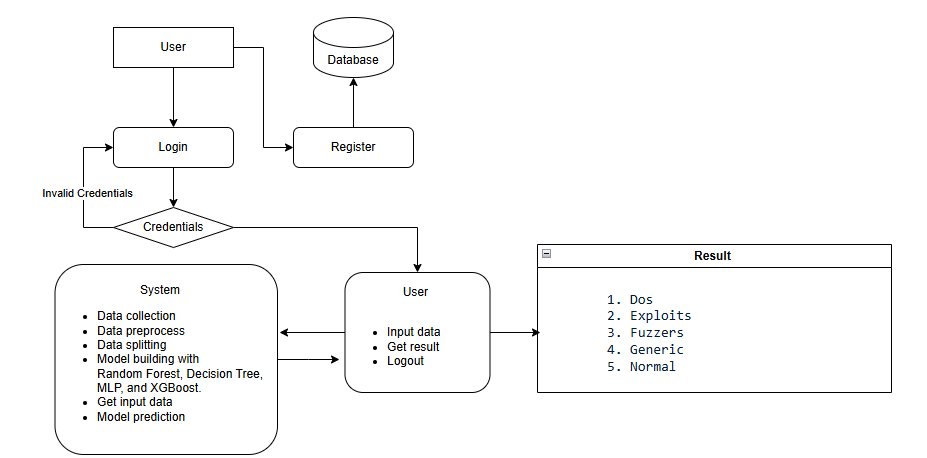
Block Diagram
Specifications
Hardware Requirements
Processor - I3/Intel Processor
Hard Disk - 160GB
Key Board - Standard Windows Keyboard
Mouse - Two or Three Button Mouse
Monitor - SVGA
RAM - 8GB
Software Requirements:
Operating System : Windows 7/8/10
Server side Script : HTML, CSS, Bootstrap & JS
Programming Language : Python
Libraries : Django, Pandas, Os, Numpy, Scikit-learn, xgboost.
IDE/Workbench : VS Code
Technology : Python 3.10
Database : SQLite

Demo Video


Request for Video
 Paper Publishing
Request Call Back
Would you like to receive a free callback now?
Choose the best time for callback:
Leave your message and we will contact you as soon as possible

6-2-85/B, Old Maternity Hospital Road, Thyagaraja Nagar, Tirupati, Andhra Pradesh – 517501
+91 9030333433
+91 9393939065
0877-2261612

Disclaimer - Takeoff Edu Group Projects are not associated or affiliated with IEEE in any way. The IEEE Projects mentioned here are mentioned in the context of student projects, whose ideas are derived from IEEE publications, not projects of or by IEEE.

