RISC-V CPU Design Using RRAM-CMOS Standard Cells
Objective
The objective is to design a RISC-V CPU architecture using hybrid RRAM-CMOS standard cells to leverage the benefits of non-volatile memory integration in logic design. This project explores the fusion of Resistive RAM (RRAM) with conventional CMOS technology to reduce power consumption, enhance area efficiency, and enable in-memory computing capabilities. The goal is to evaluate the performance, energy efficiency, and scalability of a RISC-V core implemented with RRAM-CMOS logic, aiming to advance energy-efficient processor design for emerging applications such as IoT, edge computing, and neuromorphic systems.
Abstract
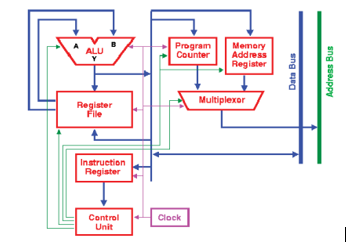
In this project, 16 bit RISC processor designed with Vedic multiplier design. Reduced Instruction Set Computer (RISC) is a design which presents better performances, higher speed of operation and favors the smaller and simpler set of instructions. The main achievement in this work is that the multiplier unit in Arithmetic and Logic Unit (ALU) and Multiplier and Accumulator (MAC) is implemented using Vedic Sutras. The main principle used in Vedic mathematics is to reduce the typical calculation of conventional mathematics to very simple one and hence reduce the overall computational complexity. In addition to these blocks, designed RISC Processor consists of other blocks like Control unit and data path, Register Bank, Program Counter and Memory. The proposed RISC processor is very simple and capable of executing 14 instructions. The achievement in this work is that savings in power in case of MAC and ALU is achieved compared to conventional ALU and MAC respectively. Also the delay is reduced in MAC and ALU in comparison with conventional ALU and MAC correspondingly. These Vedic MAC and ALU are then integrated with other blocks in processor and 16-bit Vedic processor is developed. This reduces the delay and saves power compared to conventional processor. Hence the improvement in speed of operation, reduction in power utilization and less area utilization are the key features of designed RISC processor. A 16 bit RISC processor designed in this paper is capable of executing more number of instructions with simple design, using the Verilog Hardware Description Language (HDL) and the design is simulated in the Xilinx Vivado 2018.3 design suite. We will design MRAM in Cadence Tool and we will dump in vivado for RISC Processor.
NOTE: Without the concern of our team, please don't submit to the college. This Abstract varies based on student requirements.
Block Diagram
Specifications
Software Requirements:
· Xilinx Vivado Tool
· HDL: Verilog
Hardware Requirements:
· Microsoft® Windows XP
· Intel® Pentium® 4 processor or Pentium 4 equivalent with SSE support
· 512 MB RAM
· 100 MB of available disk space
Learning Outcomes
Learning Outcomes:
- Basics of Digital Electronics
- VLSI design Flow
- Introduction to Verilog Coding
- Different modeling styles in Verilog
o Data Flow modeling
o Structural modeling
o Behavioral modeling
o Mixed level modeling
- Introduction to Arithmetic circuits
- Knowledge on MAC unit
- Different control units and instructions
- Knowledge on RISC processor
- Applications in real time
· Xilinx ISE 14.7/Xilinx Vivado for design and simulation
· Generation of Netlist
· Solution providing for real time problems
· Project Development Skills:
o Problem Analysis Skills
o Problem Solving Skills
o Logical Skills
o Designing Skills
o Testing Skills
o Debugging Skills
o Presentation Skills
o Thesis Writing Skills


 Paper Publishing

Request Call Back
Would you like to receive a free callback now?
Choose the best time for callback:
Leave your message and we will contact you as soon as possible

6-2-85/B, Old Maternity Hospital Road, Thyagaraja Nagar, Tirupati, Andhra Pradesh – 517501
+91 9030333433
+91 9393939065
0877-2261612

Disclaimer - Takeoff Edu Group Projects are not associated or affiliated with IEEE in any way. The IEEE Projects mentioned here are mentioned in the context of student projects, whose ideas are derived from IEEE publications, not projects of or by IEEE.

