Resource-Efficient Hybrid Machine Learning Model for IoT SMS Spam Detection
Objective
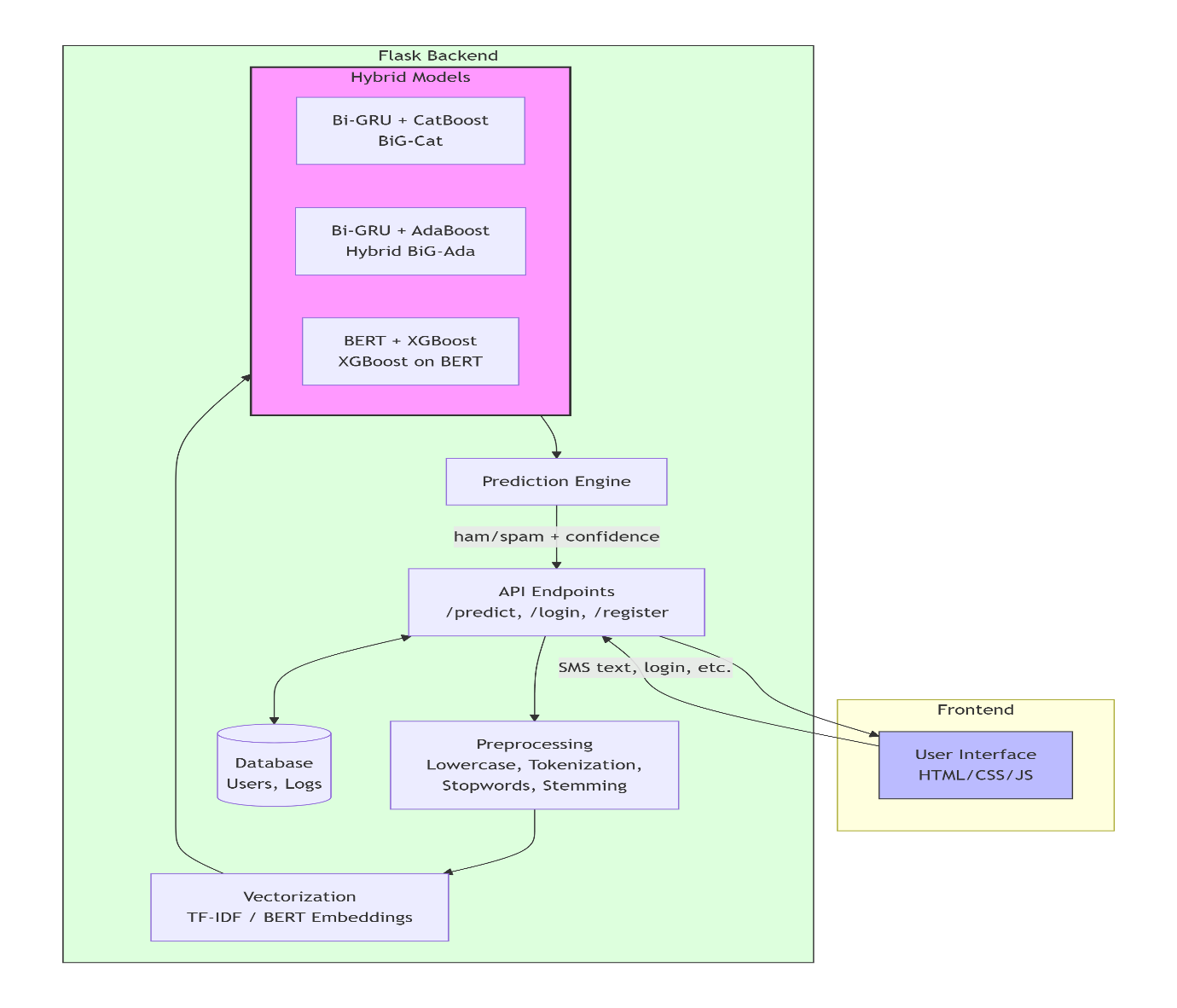
The main objective of this project is to develop a hybrid machine learning model for SMS spam classification, combining Bi-GRU with CatBoost, Bi-GRU with AdaBoost, and BERT with XGBoost to achieve high classification accuracy while optimizing resource usage. The project aims to reduce computational resource consumption, making the model suitable for environments with limited processing capabilities. It also focuses on enhancing the accuracy of spam detection through evaluation of various performance metrics such as accuracy, precision, recall, and F1-score. Furthermore, the project seeks to integrate the model into a Flask-based web application, providing a simple and user-friendly interface for users to classify SMS messages. By comparing the performance of different hybrid models, the project aims to identify the most efficient approach for SMS spam detection. Finally, the models will be tested on the spam-dataset-ucimlsms-spam-collection-dataset, ensuring the solution's adaptability to various data sources.
Abstract
The rapid growth of text-based communication in IoT devices has led to the increase of SMS spam messages. This project presents a resource-efficient hybrid machine learning model aimed at classifying SMS messages into two categories: "ham" and "spam." The approach combines Bi-GRU with CatBoost, Bi-GRU with AdaBoost, and BERT with XGBoost to create a model that efficiently detects spam while ensuring high classification accuracy. The dataset used for training contains SMS messages labeled as "ham" or "spam," each containing a text message. The proposed model is designed to reduce computational resources while achieving high performance in text classification tasks. The backend is developed using the Flask framework, while the frontend is built using HTML, CSS, and JavaScript. The combination of different machine learning techniques allows the model to handle text classification effectively with minimal resource consumption, making it suitable for IoT environments where computational power may be limited. The project focuses on optimizing both model efficiency and classification accuracy for practical applications in automated SMS filtering.
Keywords: Hybrid model, Bi-GRU, CatBoost, AdaBoost, BERT, XGBoost, SMS classification, IoT, Spam detection, Resource efficiency.
NOTE: Without the concern of our team, please don't submit to the college. This Abstract varies based on student requirements.
Block Diagram
Specifications
HARDWARE REQUIREMENTS
• Processor - I5/Intel Processor
• RAM - 8GB (min)
• Hard Disk - 160 GB
• Key Board - Standard Windows Keyboard
• Mouse - Two or Three Button Mouse
• Monitor - Any
SOFTWARE REQUIREMENS
• Operating System : Windows 7/8/10
• Server side Script : HTML, CSS, Bootstrap & JS
• Programming Language : Python
• Libraries : Flask, Pandas, Mysql.connector, Os, Numpy,
Scikit-learn.
• IDE/Workbench : VS-Code
• Technology : Python 3.10+
• Server Deployment : Xampp Server
• Database : MySQL


 Paper Publishing

Request Call Back
Would you like to receive a free callback now?
Choose the best time for callback:
Leave your message and we will contact you as soon as possible

6-2-85/B, Old Maternity Hospital Road, Thyagaraja Nagar, Tirupati, Andhra Pradesh – 517501
+91 9030333433
+91 9393939065
0877-2261612

Disclaimer - Takeoff Edu Group Projects are not associated or affiliated with IEEE in any way. The IEEE Projects mentioned here are mentioned in the context of student projects, whose ideas are derived from IEEE publications, not projects of or by IEEE.

