Residential Building Energy Usage Prediction Using Bayesian-Based Optimized XGBoost Algorithm
Objective
The objective of this project is to develop an accurate and efficient tool for predicting energy consumption, specifically Heating Load (HL) and Cooling Load (CL), in residential buildings using machine learning techniques.
Abstract
The growing demand for energy in residential buildings poses significant challenges to achieving sustainability in urban development. Energy consumption, particularly for Heating Load (HL) and Cooling Load (CL), accounts for a substantial portion of residential building energy use. Therefore, predicting energy usage during the early design phases is crucial to making informed decisions that reduce long-term energy costs and environmental impacts. This study proposes a novel approach that leverages a Bayesian-based optimization technique to enhance the performance of the eXtreme Gradient Boosting (XGBoost) algorithm in predicting HL and CL. By optimizing the hyperparameters of the XGBoost model using Bayesian optimization, we improve the model’s ability to capture complex relationships between building design features—such as wall insulation, window size, geographical location, and climate conditions—and their associated energy consumption patterns. The results demonstrate that this hybrid approach provides highly accurate predictions, outperforming traditional energy estimation methods and offering a reliable tool for architects, engineers, and designers to optimize energy efficiency in residential building designs. The proposed method not only assists in better energy management but also supports the goal of sustainable building practices by providing early-stage insights into energy performance.
Keywords:Residential buildings, Energy usage prediction, Heating Load (HL), Cooling Load (CL), eXtreme Gradient Boosting (XGBoost), Bayesian optimization, Energy efficiency, Building design characteristics, Sustainable development, Machine learning, Prediction accuracy, Early design stage analysis.
NOTE: Without the concern of our team, please don't submit to the college. This Abstract varies based on student requirements.
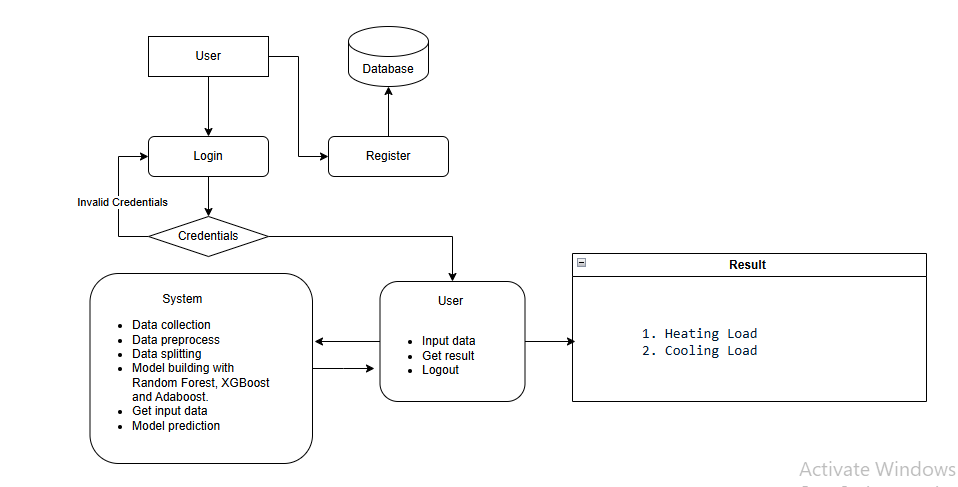
Block Diagram
Specifications
Hardware Requirements
Processor - I3/Intel Processor
Hard Disk - 160GB
Key Board - Standard Windows Keyboard
Mouse - Two or Three Button Mouse
Monitor - SVGA
RAM - 8GB
Software Requirements:
Operating System : Windows 7/8/10
Server side Script : HTML, CSS, Bootstrap & JS
Programming Language : Python
Libraries : Django, Pandas, Os, Numpy, Scikit-learn, Imblearn.
IDE/Workbench : VS Code
Technology : Python 3.10
Database : SQLite

Demo Video


Request for Video
 Paper Publishing
Request Call Back
Would you like to receive a free callback now?
Choose the best time for callback:
Leave your message and we will contact you as soon as possible

6-2-85/B, Old Maternity Hospital Road, Thyagaraja Nagar, Tirupati, Andhra Pradesh – 517501
+91 9030333433
+91 9393939065
0877-2261612

Disclaimer - Takeoff Edu Group Projects are not associated or affiliated with IEEE in any way. The IEEE Projects mentioned here are mentioned in the context of student projects, whose ideas are derived from IEEE publications, not projects of or by IEEE.

