Reliable Multistate RRAM Devices for Reconfigurable CAM and IMC Applications
Also Available Domains Nano Technology
Objective
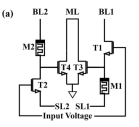
Integrate these RRAM devices with MOS transistors to build a 4T2R array, enabling reconfigurable analog voltage-based Content-Addressable Memory (CAM) and In-Memory Computing (IMC) accelerators.
Abstract
This paper presents the design and implementation of a reconfigurable Content Addressable Memory (CAM) architecture integrated with an analog tunable selector, aimed at improving the flexibility, energy efficiency, and density of search-based memory systems. Traditional CAMs suffer from high power consumption due to parallel comparisons and lack adaptability for evolving workloads. In the proposed design, resistive memory (RRAM) elements are employed for compact data storage, while the analog tunable selector—implemented using a voltage-controlled switching mechanism—enables dynamic adjustment of matching thresholds and access conditions. This allows for reconfigurable search operations, supporting both exact and approximate matching modes, which is particularly useful in error-tolerant applications like image recognition and associative computing. The circuit-level design is validated through simulations in LTspice, demonstrating correct match/mismatch detection and significant potential for low-power operation. This architecture opens the path toward intelligent memory systems capable of adaptive behavior with minimal area and power overhead.
Index Terms— Resistive Random-Access Memory (RRAM), Multistate Memory, Reconfigurable Content Addressable Memory (CAM), In-Memory Computing (IMC), Non-Volatile Memory, Reliability, Variability, Low-Power Design, Emerging Memory Devices.
NOTE: Without the concern of our team, please don't submit to the college. This Abstract varies based on student requirements.
Block Diagram
Specifications
Software Requirements:
· Tool: LT SPICE
Hardware Requirements:
· Microsoft® Windows XP
· Intel® Pentium® 4 processor or Pentium 4 equivalent with SSE support
· 512 MB RAM
· 100 MB of available disk space
Learning Outcomes
• Introduction to Digital electronics
• Introduction to logic gates
• Importance of Transistors
o Types of adders
o NMOS/PMOS/CMOS Technologies
o How to design circuits using Transistor logic?
• Introduction to Digital electronics
• Introduction to logic gates
• Importance of Transistors
o Types of adders
o NMOS/PMOS/CMOS Technologies
o How to design circuits using Transistor logic?
Demo Video


Request for Video
Related Projects
 Paper Publishing
Request Call Back
Would you like to receive a free callback now?
Choose the best time for callback:
Leave your message and we will contact you as soon as possible

6-2-85/B, Old Maternity Hospital Road, Thyagaraja Nagar, Tirupati, Andhra Pradesh – 517501
+91 9030333433
+91 9393939065
0877-2261612

Disclaimer - Takeoff Edu Group Projects are not associated or affiliated with IEEE in any way. The IEEE Projects mentioned here are mentioned in the context of student projects, whose ideas are derived from IEEE publications, not projects of or by IEEE.

