Recognition of Sitting Posture Using Deep Learning and OpenCV
Objective
We provide a method for detecting body sitting posture in OpenCV using Open Pose CNN technology in this study.
Abstract
Because of its essential issues and wide range of applications, vision-based human posture identification has piqued the interest of many researchers. The applications in surveillance systems range from simple posture recognition to complex behaviour comprehension. This leads to significant advancements in techniques for representing and recognising human body position. The applications and general framework of human body position identification are discussed in this research. We provide a method for detecting body sitting posture in OpenCV using OpenPose CNN technology in this study. The report also highlights its benefits and drawbacks. The domain of human body posture recognition has been active for over two decades and has produced a substantial amount of literature. The report also discusses some different approaches for detecting human position, as well as their pros and shortcomings. Adolescents' health can be harmed by sedentary behaviour and bad seating position. As a result, it is highly practical to efficiently identify and warn pupils about their sitting posture in the classroom. This research suggested an OpenPose-based in-class student sitting posture identification system that leverages the classroom monitor to identify students' sitting position and OpenPose to extract the posture feature. The convolutional neural network, which is used to train datasets and distinguish sitting posture of Body, is built using the Keras deep learning framework.
Human health is harmed by poor sitting posture. People can be reminded to correct their sitting posture using an intelligent sitting posture recognition algorithm. A seated pressure image acquisition system was devised in this paper. We introduced a unique hip positioning algorithm based on hip templates with the system. The algorithm's average variance for hip placement is 1.306 pixels (corresponding distance: 1.50 cm), and 94.1 percent of the maximum positioning deviation is less than three pixels. Statistics show that the algorithm performs admirably for a variety of subjects. At the same time, the algorithm is capable of not only accurately locating the hip location with a small rotation angle (0–15), but also adapting to the sitting posture with a medium rotation angle (15–30). Alternatively, a large rotation angle (30–45) might be used. The regional pressure values of the left hip, right hip, and caudal vertebrae are efficiently retrieved as features using the hip positioning algorithm.
Keywords: categorization of sitting posture, CNN, OpenCV, Open Pose
NOTE: Without the concern of our team, please don't submit to the college. This Abstract varies based on student requirements.
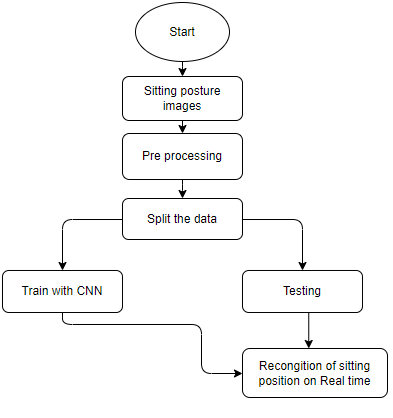
Block Diagram
Specifications
H/W Specifications:
- Processor:
I5/Intel Processor
- RAM : 8GB (min)
- Hard Disk : 128 GB
S/W Specifications:
- Operating System: Windows 10
- Server-side Script : Python 3.6
- IDE: Pycharm, VS code
- Libraries Used : Numpy, IO, OS, Keras, pandas, tensorflow, Opencv
Learning Outcomes
Practical exposure to
· Hardware and software tools
· Solution providing for real time problems
· Working with team/individual
· Work on creative ideas
· Testing techniques
· Error correction mechanisms
· What type of technology versions is used?
· Working of Tensor Flow
· Implementation of Deep Learning techniques
· Working of CNN algorithm
· Working of Transfer Learning methods
· Building of model creations
· Scope of project
· Applications of the project
· About Python language
· About Deep Learning Frameworks
· Use of Data Science


 Paper Publishing

Request Call Back
Would you like to receive a free callback now?
Choose the best time for callback:
Leave your message and we will contact you as soon as possible

6-2-85/B, Old Maternity Hospital Road, Thyagaraja Nagar, Tirupati, Andhra Pradesh – 517501
+91 9030333433
+91 9393939065
0877-2261612

Disclaimer - Takeoff Edu Group Projects are not associated or affiliated with IEEE in any way. The IEEE Projects mentioned here are mentioned in the context of student projects, whose ideas are derived from IEEE publications, not projects of or by IEEE.

