Real-Time Urban Flood Forecasting And Alert System
Objective
The objective of this project is to predict flood probabilities using machine learning models, compare model performance, and provide a data-driven approach for effective disaster management and preparedness.
Abstract
Flood prediction is critical for mitigating the devastating impacts of floods on communities and infrastructure. This project aims to develop a machine learning-based model to predict the probability of flooding in a given region using various environmental and socio-economic factors. The dataset used for this project includes 21 features such as monsoon intensity, deforestation, climate change, and urbanization, with the target variable being FloodProbability, a continuous value between 0 and 1. We apply four different regression algorithms—Linear Regression, XGBoost Regressor, Random Forest Regressor, and Stacking Regressor—to predict the flood probability. Data preprocessing techniques such as feature scaling and data splitting are used to prepare the data for model training. The models are evaluated using performance metrics like Mean Squared Error (MSE) and R² score. Among the models, the Stacking Regressor and Linear Regression show the best performance, achieving an R² of 0.8449. This project highlights the potential of machine learning models to improve flood prediction accuracy, providing a useful tool for disaster preparedness and resource allocation.
NOTE: Without the concern of our team, please don't submit to the college. This Abstract varies based on student requirements.
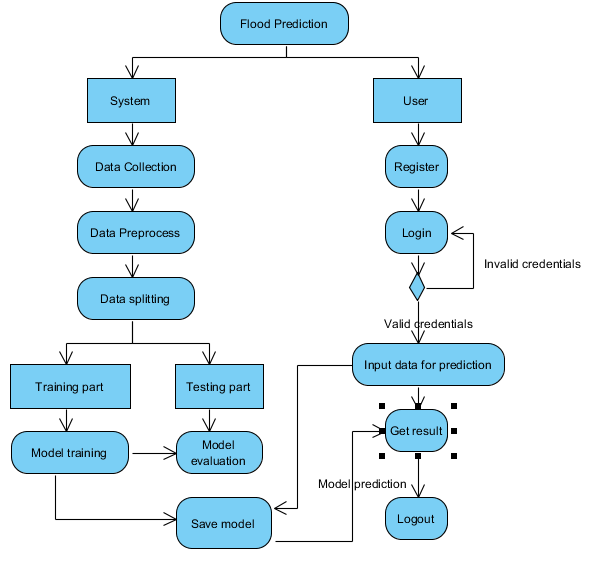
Block Diagram
Specifications
Hardware Requirements
Processor - I3/Intel Processor
Hard Disk - 160GB
Key Board - Standard Windows Keyboard
Mouse - Two or Three Button Mouse
Monitor - SVGA
RAM - 8GB
Software Requirements
• Operating System : Windows 7/8/10
• Programming Language : Python
• Libraries : Pandas, Numpy, scikit-learn.
• IDE/Workbench : Visual Studio Code.


 Paper Publishing

Request Call Back
Would you like to receive a free callback now?
Choose the best time for callback:
Leave your message and we will contact you as soon as possible

6-2-85/B, Old Maternity Hospital Road, Thyagaraja Nagar, Tirupati, Andhra Pradesh – 517501
+91 9030333433
+91 9393939065
0877-2261612

Disclaimer - Takeoff Edu Group Projects are not associated or affiliated with IEEE in any way. The IEEE Projects mentioned here are mentioned in the context of student projects, whose ideas are derived from IEEE publications, not projects of or by IEEE.

