Real time sepsis prediction using tcn and tiny ml
Objective
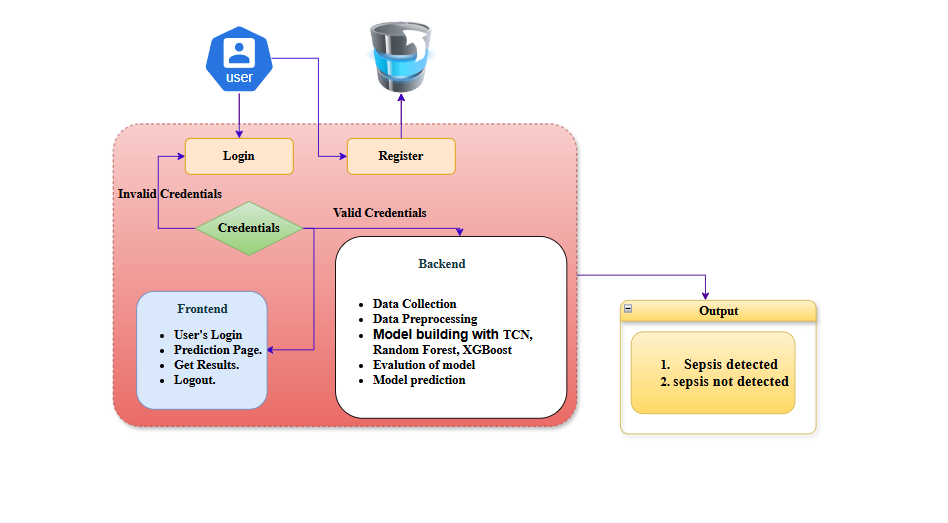
The objective of this project is to develop an intelligent and efficient system for the early prediction of sepsis using advanced machine learning and deep learning techniques. The primary goal is to classify patient conditions into two categories — Sepsis Detected and Sepsis Not Detected — based on physiological and clinical parameters. The project leverages the Temporal Convolutional Network (TCN) to effectively model temporal dependencies in medical time-series data, enhancing prediction accuracy. Additionally, traditional models such as Random Forest and XGBoost are implemented for comparative performance analysis. The system aims to provide healthcare professionals with an assistive diagnostic tool capable of performing real-time prediction, supporting faster decision-making and improving patient
Abstract
Sepsis is a life-threatening medical condition caused by the body’s extreme response to infection, leading to tissue damage, organ failure, and death if not identified early. This project proposes an intelligent sepsis prediction system using deep learning and Tiny Machine Learning (TinyML) techniques to provide efficient and rapid detection in healthcare environments. The system integrates Temporal Convolutional Networks (TCN) for sequential data modeling and compares its performance with classical machine learning models such as Random Forest and XGBoost. The proposed model analyzes patient physiological parameters and vital signs to classify the condition as “Sepsis Detected” or “Sepsis Not Detected.” The TCN architecture effectively captures temporal dependencies in medical time-series data, enhancing early diagnosis accuracy. Meanwhile, TinyML deployment ensures low-power, resource-efficient prediction suitable for edge healthcare devices. The project employs Python with Flask for backend processing and HTML, CSS, and JavaScript for the user interface, offering an interactive platform for real-time prediction and visualization. By combining deep learning with TinyML, the system aims to support clinicians with fast, reliable, and accessible sepsis detection, improving patient survival rates and advancing intelligent healthcare monitoring systems.
Keywords: Sepsis Prediction, Temporal Convolutional Network (TCN), Random Forest, XGBoost, TinyML, Flask, Healthcare Analytics, Deep Learning, Early Diagnosis, Time-Series Data.
NOTE: Without the concern of our team, please don't submit to the college. This Abstract varies based on student requirements.
Block Diagram
Specifications
SOFTWARE REQUIREMENS
Operating System : Windows 7/8/10
Server side Script : html,css,js
Programming Language : Python
Libraries : Django, Pandas, Torch, Keras, Sklearn,Numpy , Seaborn
IDE/Workbench : VSCode
Server Deployment : Xampp Server
Database : SQLite
HARDWARE REQUIREMENTS
Processor - I3/Intel Processor
RAM - 8GB (min)
Hard Disk - 128 GB
Key Board - Standard Windows Keyboard
Mouse - Two or Three Button Mouse
Monitor - Any


 Paper Publishing

Request Call Back
Would you like to receive a free callback now?
Choose the best time for callback:
Leave your message and we will contact you as soon as possible

6-2-85/B, Old Maternity Hospital Road, Thyagaraja Nagar, Tirupati, Andhra Pradesh – 517501
+91 9030333433
+91 9393939065
0877-2261612

Disclaimer - Takeoff Edu Group Projects are not associated or affiliated with IEEE in any way. The IEEE Projects mentioned here are mentioned in the context of student projects, whose ideas are derived from IEEE publications, not projects of or by IEEE.

