Real-time Machine Learning-Based Physical Model for Estimating Photovoltaic Output Power Using Meteorological Data
Objective
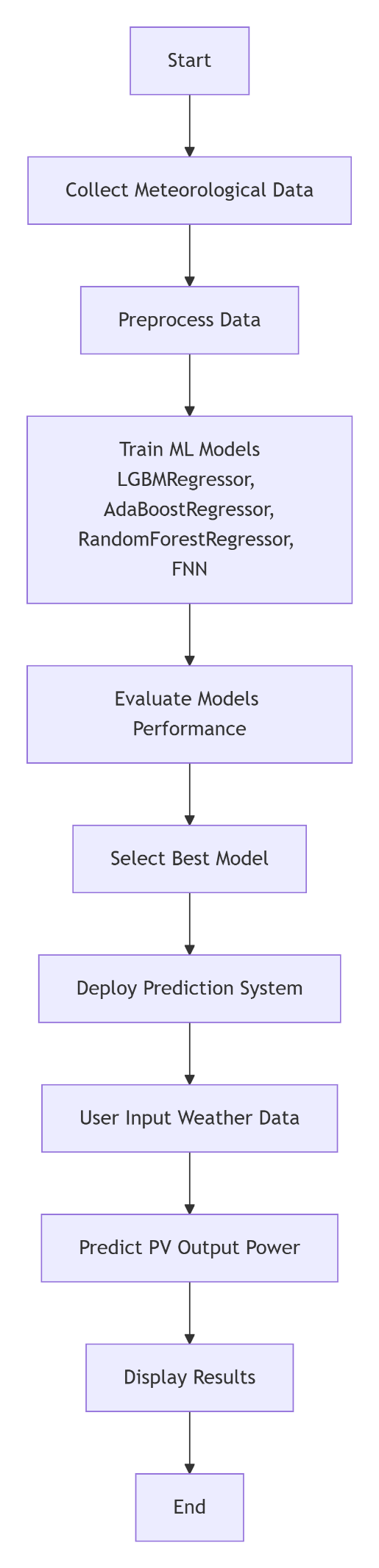
The objective of this project is to develop an efficient and accurate machine learning model that predicts photovoltaic (PV) output power based on meteorological data. The primary goal is to train a machine learning model using environmental factors such as temperature, humidity, wind speed, and cloud coverage to estimate the power generated by PV systems. This will be achieved by utilizing a combination of machine learning algorithms, including LGBMRegressor, AdaBoostRegressor, RandomForestRegressor, and Feedforward Neural Network (FNN), to enhance the accuracy of the predictions. The project will also focus on creating a user-friendly web application, built using Flask, HTML, CSS, and JavaScript, where users can input their location and weather data to receive predicted PV output. By doing so, the system will help solar energy producers optimize their power generation and improve energy management by providing more reliable forecasts. The project will evaluate and compare the performance of different machine learning models to select the most suitable one for deployment. Ultimately, the project aims to create a scalable, easy-to-use solution that enables better planning, optimization, and integration of solar energy systems.
Abstract
This project focuses on creating a machine learning-based model to estimate photovoltaic (PV) output power using meteorological data. Solar energy is heavily influenced by environmental factors such as temperature, humidity, wind speed, and cloud coverage. Accurate predictions of PV output are crucial for optimizing the utilization of solar energy systems. The model employs machine learning algorithms including LGBMRegressor, AdaBoostRegressor, RandomForestRegressor, and Feedforward Neural Network (FNN) to forecast the amount of power generated by PV systems. By analyzing historical data that includes various meteorological factors, the model is trained to estimate the energy produced by PV panels based on specific weather conditions. The project uses a Flask-based web application to allow users to input location and weather data and receive output power predictions. The ultimate goal is to provide a reliable and efficient method for estimating PV output, which can assist in improving energy management, helping solar energy producers optimize their systems and enhancing grid stability.
Keywords: photovoltaic, power estimation, meteorological data, machine learning, LGBMRegressor, AdaBoostRegressor, RandomForestRegressor, Feedforward Neural Network, weather conditions, energy optimization
NOTE: Without the concern of our team, please don't submit to the college. This Abstract varies based on student requirements.
Block Diagram
Specifications
HARDWARE REQUIREMENTS
• Processor - I5/Intel Processor
• RAM - 8GB (min)
• Hard Disk - 160 GB
• Key Board - Standard Windows Keyboard
• Mouse - Two or Three Button Mouse
• Monitor - Any
SOFTWARE REQUIREMENS
• Operating System : Windows 7/8/10
• Server side Script : HTML, CSS, Bootstrap & JS
• Programming Language : Python
• Libraries : Flask, Pandas, Mysql.connector, Os, Numpy,
Scikit-learn.
• IDE/Workbench : VS-Code
• Technology : Python 3.10+
• Server Deployment : Xampp Server
• Database : MySQL


 Paper Publishing

Request Call Back
Would you like to receive a free callback now?
Choose the best time for callback:
Leave your message and we will contact you as soon as possible

6-2-85/B, Old Maternity Hospital Road, Thyagaraja Nagar, Tirupati, Andhra Pradesh – 517501
+91 9030333433
+91 9393939065
0877-2261612

Disclaimer - Takeoff Edu Group Projects are not associated or affiliated with IEEE in any way. The IEEE Projects mentioned here are mentioned in the context of student projects, whose ideas are derived from IEEE publications, not projects of or by IEEE.

