Raspberry Pi-Based Non-Invasive Anemia Detection via Palpebral Conjunctiva Image Analysis
Objective
Raspberry Pi-Based Non-Invasive Anemia Detection via Palpebral Conjunctiva Image Analysis The objective of Raspberry Pi-Based Non-Invasive Anemia Detection via Palpebral Conjunctiva Image Analysis is to develop a low-cost system that analyzes eye images to detect anemia without blood tests. This enables quick, portable, and non-invasive health screening.
Abstract
This study proposes a low-cost, non-invasive anemia detection system based on palpebral conjunctiva image analysis using a Raspberry Pi platform. The system captures high-quality images of the palpebral conjunctiva—the inner surface of the lower eyelid—using a USB webcam connected to the Raspberry Pi. These images are pre-processed to enhance relevant features, such as color and texture, which are indicative of hemoglobin levels. A dataset of labeled palpebral conjunctiva images, collected from subjects with varying degrees of anemia, is used to train machine learning models. Feature extraction techniques, including color histogram analysis and image segmentation, are applied to highlight the conjunctiva region. The extracted features are then fed into a classifier, such as Support Vector Machine (SVM) or a lightweight Convolutional Neural Network (CNN), which is trained to distinguish between normal and anemic cases, as well as classify the severity of anemia. The trained model is deployed on the Raspberry Pi, enabling real-time anemia detection and classification through image analysis displayed on an attached LCD screen. This approach offers a portable, accessible, and efficient tool for anemia screening, especially useful in remote or resource-limited areas where conventional blood testing is not feasible.
NOTE: Without the concern of our team, please don't submit to the college. This Abstract varies based on student requirements.
Block Diagram
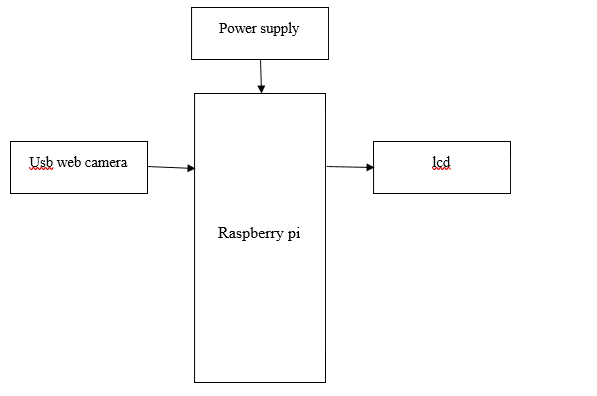
Specifications
Hardware requirements:
- Raspberry pi
- Memory card
- Usb web camera
- Lcd
- Power supply
Software requirements:
- Raspbean os
- Python idle
Learning Outcomes
Understanding Raspberry pi pin diagram and architecture
Installing and configuring python IDE for Raspberry pi
Setting up Raspberry pi for multi-sensor
Basic coding with Raspberry pi for applications
Interfacing LCD with Arduino for real-time display
Interfacing usb web camera with Raspberry pi
Understanding power supply requirements for wearable devices
About Project Development Life Cycle:
- Planning and Requirement Gathering (software, tools, hardware components, etc.)
- Schematic preparation
- Code development and debugging
- Hardware setup and debugging
- Development of the Project and Output testing
Practical exposure to:
- Hardware and software tools
- Solution providing for real-time problems
- Working with a team/individually
- Working on creative ideas
Project development skills:
- Problem analysis
- Problem solving
- Creativity and imagination
- Programming skills (Python)
- Deployment
- Testing
- Debugging
- Project presentation
- Report writing


 Paper Publishing

Request Call Back
Would you like to receive a free callback now?
Choose the best time for callback:
Leave your message and we will contact you as soon as possible

6-2-85/B, Old Maternity Hospital Road, Thyagaraja Nagar, Tirupati, Andhra Pradesh – 517501
+91 9030333433
+91 9393939065
0877-2261612

Disclaimer - Takeoff Edu Group Projects are not associated or affiliated with IEEE in any way. The IEEE Projects mentioned here are mentioned in the context of student projects, whose ideas are derived from IEEE publications, not projects of or by IEEE.

