Raspberry Pi Base System Architecture For Tracking Passengers Inside An Airport Terminal Using Rfid
Also Available Domains WSN
Abstract
Experts predict the number of devices connected to Internet of Things will reach 50 billion in 2020. In this paper, we apply the concept of IoT to the airport management industry and investigate the utilization of RFID technology to enhance airport mobility and security. We propose a system to track passengers inside an airport terminal and focus on the optimization of its architecture. To that end, we develop a simulation model incorporating the most important parts of the system, including: An airport model based on Chicago O’Hare International Airport, a passenger trajectory model, a link budget model, a coverage model, a reader placement algorithm, a communication protocol and the limitations of available RFID technology and regulations. Next, we identify a set of architectural decisions, such as the physical limits of the system or the specific technology to be deployed, and develop performance and cost metrics to compare the plausible architectures. Then, based on the developed model and the metrics space, we present the architectural trade space of the system and analyze the impact each decision has in order to optimize the architecture. Finally, we assess the viability of the chosen architecture in terms of coverage and tracking performance.
NOTE: Without the concern of our team, please don't submit to the college. This Abstract varies based on student requirements.
Block Diagram
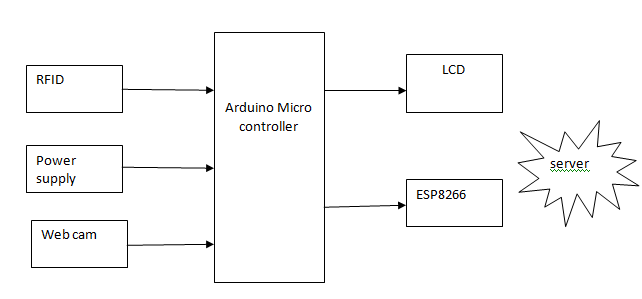
Specifications
Learning Outcomes
- Understanding Arduino architecture and pin diagram
- Installation and setup of Arduino IDE
- Programming and interfacing Arduino with sensors
- Interfacing RFID Reader
- Working of Esp8266
- Interfacing LCD with Arduino
- Working of Web camera
- Understanding transformer protection and monitoring techniques
- About Project Development Life Cycle:
- Planning and Requirement Gathering (software’s, Tools, Hardware components, etc.,)
- Schematic preparation
- Code development and debugging
- Hardware development and debugging
- Development of the Project and Output testing
- Practical exposure to:
- Hardware and software tools.
- Solution providing for real time problems.
- Working with team/ individual.
- Work on Creative ideas.
- Project development Skills
- Problem analyzing skills
- Problem solving skills
- Creativity and imaginary skills
- Programming skills
- Deployment
- Testing skills
- Debugging skills
- Project presentation skills
- Thesis writing skills


 Paper Publishing

Request Call Back
Would you like to receive a free callback now?
Choose the best time for callback:
Leave your message and we will contact you as soon as possible

6-2-85/B, Old Maternity Hospital Road, Thyagaraja Nagar, Tirupati, Andhra Pradesh – 517501
+91 9030333433
+91 9393939065
0877-2261612

Disclaimer - Takeoff Edu Group Projects are not associated or affiliated with IEEE in any way. The IEEE Projects mentioned here are mentioned in the context of student projects, whose ideas are derived from IEEE publications, not projects of or by IEEE.

