RASC: A Low-Power Reconfigurable 4-2 Adder-Subtractor-Compressor
Objective
1. To study the design principles of arithmetic circuits, particularly adders, subtractors, and compressors, and understand their role in high-speed digital systems. 2. To design a 4-2 adder-subtractor-compressor module that is reconfigurable, allowing the circuit to perform addition, subtraction, or compression operations based on control signals.
Abstract
In modern digital signal processing and arithmetic circuits, efficient utilization of hardware resources with reduced power consumption and high performance remains critical. This paper presents RASC, a low‑power and reconfigurable 4‑2 adder‑subtractor‑compressor architecture. RASC supports multiple arithmetic operations — addition, subtraction, and compression — within a single adaptive hardware block. The design leverages optimized logic restructuring and reconfigurable datapaths to minimize switching activities and power usage without penalizing performance. Simulation and synthesis results demonstrate significant improvement in power efficiency and area utilization compared to traditional designs, making RASC suitable for low‑power embedded systems and high‑throughput applications.
NOTE: Without the concern of our team, please don't submit to the college. This Abstract varies based on student requirements.
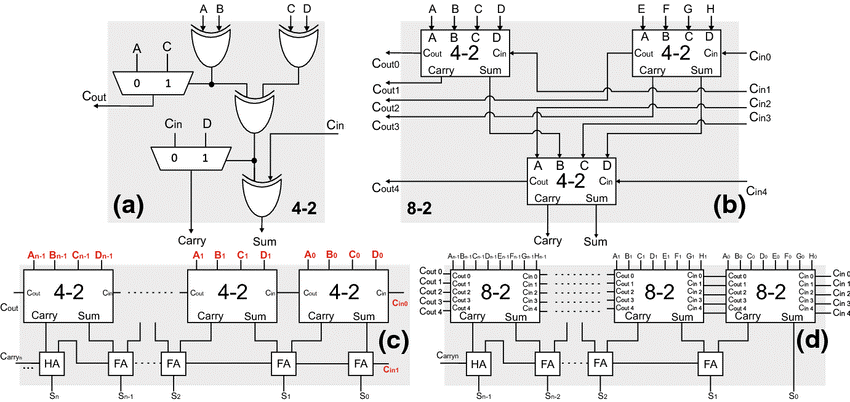
Block Diagram
Specifications
Software Requirements
- Xilinx Vivado Design Suite (2020.2 or later)
- Verilog HDL for RTL design and implementation
- Vivado Simulator (XSIM) for functional and timing verification
- MATLAB (optional) for GPR data preprocessing, noise modeling, and result validation
Hardware Requirements
- Microsoft® Windows 10 / Windows 11 (64-bit)
- Intel® Core™ i5 / i7 Processor or equivalent
- Minimum 8 GB RAM
- Minimum 500 MB free disk space
Learning Outcomes
By studying the RASC architecture and related arithmetic designs, learners will be able to:
Understand the trade‑offs between fixed and reconfigurable arithmetic units.
Analyze the impact of carry propagation and logic depth on latency.
Design low‑power arithmetic circuits using logic sharing and optimization techniques.
Integrate reconfigurable arithmetic blocks into larger digital systems.
Evaluate performance metrics such as area, power, and throughput in hardware design.


 Paper Publishing

Request Call Back
Would you like to receive a free callback now?
Choose the best time for callback:
Leave your message and we will contact you as soon as possible

6-2-85/B, Old Maternity Hospital Road, Thyagaraja Nagar, Tirupati, Andhra Pradesh – 517501
+91 9030333433
+91 9393939065
0877-2261612

Disclaimer - Takeoff Edu Group Projects are not associated or affiliated with IEEE in any way. The IEEE Projects mentioned here are mentioned in the context of student projects, whose ideas are derived from IEEE publications, not projects of or by IEEE.

