Randomized Explainable Machine Learning Models for Efficient Medical Diagnosis.
Objective
The efficient diagnosis of heart disease is a critical aspect of healthcare, requiring accurate and timely prediction systems. This project investigates the use of randomized explainable machine learning models to improve heart disease diagnosis. A combination of Random Forest, Gradient Boosting, and Convolutional Neural Networks (CNN) is employed to classify the two primary classes: "Heart Disease" and "No Heart Disease." The Random Forest model is utilized for its ability to handle high-dimensional data and its interpretability, making it effective for understanding the key features influencing predictions. Gradient Boosting is integrated to enhance predictive performance by sequentially correcting the errors made by weak models, while CNN models are used for their capability to automatically extract relevant features from medical datasets. The models are developed using Python and machine learning frameworks such as Scikit-learn and TensorFlow. Evaluation metrics including accuracy, precision, recall, and F1-score are utilized to assess the performance of these models. This research emphasizes the potential of combining traditional machine learning algorithms with deep learning models to deliver accurate, interpretable, and efficient solutions for heart disease diagnosis, offering healthcare professionals a powerful tool for early disease detection and decision-making.
Abstract
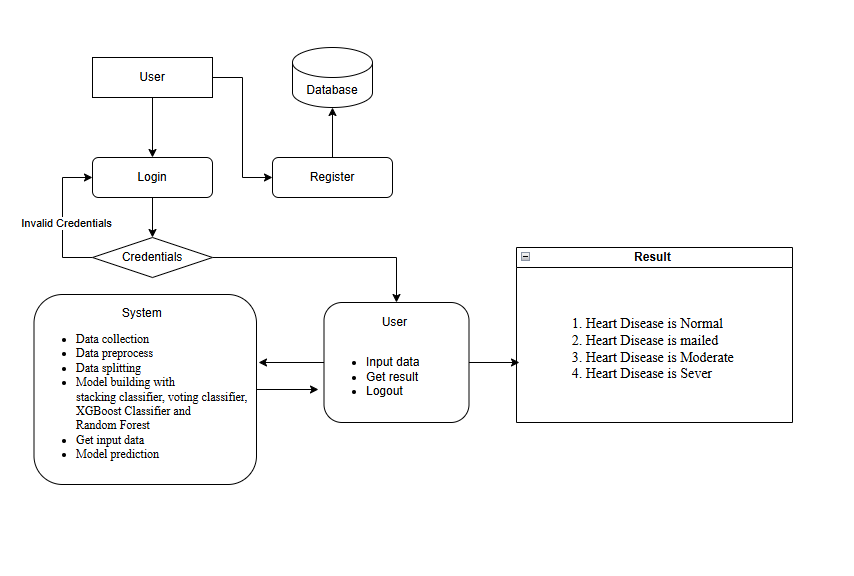
The integration of machine learning (ML) in medical diagnostics has significantly advanced the accuracy and efficiency of disease detection. However, conventional deep learning and deterministic models often face challenges such as high computational overhead and lack of interpretability, limiting their deployment in resource-constrained healthcare environments. This study presents a comprehensive analysis of randomized explainable machine learning models for efficient medical diagnosis. The proposed framework leverages ensemble-based classifiers—Random Forest, XGBoost Classifier, Stacking Classifier, and Voting Classifier—to balance predictive accuracy, computational efficiency, and interpretability. Randomization within these algorithms enhances generalization, reduces overfitting, and accelerates model training. Furthermore, explainability methods are incorporated to ensure transparent decision-making, aiding clinicians in understanding key diagnostic features influencing predictions. The comparative evaluation demonstrates that randomized ensemble classifiers achieve near state-of-the-art diagnostic performance while significantly lowering computational costs. This approach enables faster, reliable, and interpretable predictions suitable for time-sensitive medical applications, offering a promising pathway toward sustainable, explainable, and efficient healthcare AI systems.
Keywords: Randomized Machine Learning, Explainable AI, Medical Diagnosis, Random Forest, XGBoost, Ensemble Learning, Stacking Classifier, Voting Classifier, Computational Efficiency, Healthcare Analytics.
NOTE: Without the concern of our team, please don't submit to the college. This Abstract varies based on student requirements.
Block Diagram
Specifications
Hardware Requirements
Processor - I3/Intel Processor
Hard Disk - 160GB
Key Board - Standard Windows Keyboard
Mouse - Two or Three Button Mouse
Monitor - SVGA
RAM - 8GB
Software Requirements:
Operating System : Windows 7/8/10
Server side Script : HTML, CSS, Bootstrap & JS
Programming Language : Python
Libraries : Django, Pandas, Numpy, Tensorflow, Scikit-learn.
IDE/Workbench : VS Code
Technology : Python 3.10
Database : SQLite

Demo Video


Request for Video
 Paper Publishing
Request Call Back
Would you like to receive a free callback now?
Choose the best time for callback:
Leave your message and we will contact you as soon as possible

6-2-85/B, Old Maternity Hospital Road, Thyagaraja Nagar, Tirupati, Andhra Pradesh – 517501
+91 9030333433
+91 9393939065
0877-2261612

Disclaimer - Takeoff Edu Group Projects are not associated or affiliated with IEEE in any way. The IEEE Projects mentioned here are mentioned in the context of student projects, whose ideas are derived from IEEE publications, not projects of or by IEEE.

