Randomization-Driven Hybrid Deep Learning for Diabetic Retinopathy Detection
Objective
This project aims to develop an intelligent system for Diabetic Retinopathy detection using image analysis. It combines handcrafted and deep learning features, applies preprocessing, vessel segmentation, and feature extraction via MS-LBP and CNN. Classification uses SVM, RNN, GRU, and hybrid models like CNN-RBF, aiming to improve diagnostic accuracy and support scalable, reliable DR screening.
Abstract
Diabetic Retinopathy (DR) is a severe eye disease in diabetics that can lead to retinal damage and blindness if not properly managed. Traditional DR screening by ophthalmologists is time-consuming, prompting the need for more efficient methods. This project leverages Deep Learning (DL) to automate DR detection using MobileNet, a lightweight model trained on 3,662 high-resolution fundus images from the APTOS dataset hosted on Kaggle. The MobileNet model classifies DR into five stages—zero through four. To enhance performance further, we explore hybrid models combining MobileNet with other architectures: MobileNet + Graph Neural Network (GNN) and MobileNet + Recurrent Neural Network (RNN). The MobileNet + GNN hybrid aims to capture complex spatial relationships within retinal images, potentially improving classification by interpreting structural patterns. The MobileNet + RNN hybrid seeks to address sequential dependencies and temporal patterns, enhancing the model's ability to detect nuanced changes across different DR stages. These hybrid approaches aim to optimize DR detection, improving both accuracy and efficiency.
Keywords - Deep learning, diabetic retinopathy, dataset, MobileNet, Graph Neural Network (GNN), Recurrent Neural Network (RNN).
NOTE: Without the concern of our team, please don't submit to the college. This Abstract varies based on student requirements.
Block Diagram
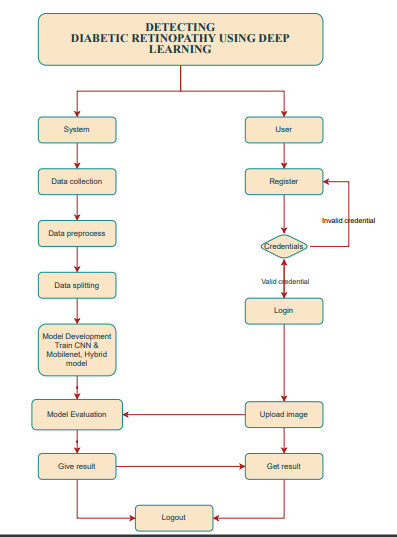
Specifications
H/W Specifications:
· Processor : I5/Intel Processor
· RAM : 8GB (min)
· Hard Disk : 128 GB
S/W Specifications:
• Operating System : Windows 10
• Server-side Script : Python 3.6
• IDE : PyCharm, Jupyter notebook
• Libraries Used : Numpy, IO, OS, Flask, Keras, pandas, tensorflow


 Paper Publishing

Request Call Back
Would you like to receive a free callback now?
Choose the best time for callback:
Leave your message and we will contact you as soon as possible

6-2-85/B, Old Maternity Hospital Road, Thyagaraja Nagar, Tirupati, Andhra Pradesh – 517501
+91 9030333433
+91 9393939065
0877-2261612

Disclaimer - Takeoff Edu Group Projects are not associated or affiliated with IEEE in any way. The IEEE Projects mentioned here are mentioned in the context of student projects, whose ideas are derived from IEEE publications, not projects of or by IEEE.

