RADIO LINK FAILURE PREDICTION FOR 5G COMMUNICATION RELIABILITY USING ML
Objective
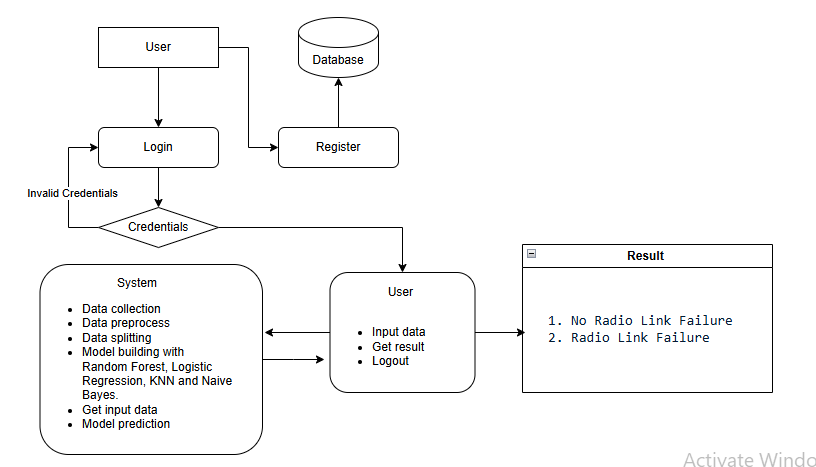
The primary objective of this project is to develop a predictive model for Radio Link Failure (RLF) in 5G networks, enhancing communication reliability. By leveraging machine learning techniques, the project aims to predict RLF occurrences up to five days in advance, utilizing past RLF data and real-time weather forecast information. The system focuses on preprocessing and feature engineering to optimize the prediction accuracy. Additionally, the project compares multiple algorithms, including Random Forest, Logistic Regression, K-Nearest Neighbors (KNN), and Naive Bayes, to identify the most efficient model for improving 5G network performance and reducing latency.
Abstract
The rapid evolution of 5G mobile networks, ensuring stable and high-quality Internet connectivity has become critical. Radio Link Failure (RLF), caused by environmental factors such as weather conditions, wind, and surrounding physical infrastructure, is a significant challenge that can disrupt communication reliability. This research aims to predict the occurrence of RLF events using machine learning (ML) techniques to enhance 5G communication performance. By incorporating novel preprocessing and feature engineering methods, the study employs a decision tree model trained on comprehensive datasets to predict RLF occurrences not only for the immediate future but also for up to five days ahead. The prediction model integrates historical RLF data with weather forecast information from local weather stations to account for the impact of environmental changes on radio link stability. In addition to the decision tree model, various algorithms, including Random Forest, Logistic Regression, K-Nearest Neighbors (KNN), and Naive Bayes, were explored for comparative analysis of prediction accuracy. The proposed system provides a low-cost, reliable solution for improving 5G network reliability, ensuring increased capacity, and reducing latency, which are vital for the growing demands of modern communication systems.
Keywords:
5G Communication, Radio Link Failure (RLF), Machine Learning, Prediction Model, Decision Tree, Feature Engineering, Random Forest, Logistic Regression, K-Nearest Neighbors (KNN), Naive Bayes, Weather Forecast, Network Reliability, Environmental Factors, Latency Reduction, Data Preprocessing, Internet Connectivity.
NOTE: Without the concern of our team, please don't submit to the college. This Abstract varies based on student requirements.
Block Diagram
Specifications
Hardware Requirements
Processor - I3/Intel Processor
Hard Disk - 160GB
Key Board - Standard Windows Keyboard
Mouse - Two or Three Button Mouse
Monitor - SVGA
RAM - 8GB
Software Requirements:
Operating System : Windows 7/8/10
Server side Script : HTML, CSS, Bootstrap & JS
Programming Language : Python
Libraries : Django, Pandas, Numpy, Imblearn, Scikit-learn.
IDE/Workbench : VS Code
Technology : Python 3.10
Database : SQLite


 Paper Publishing

Request Call Back
Would you like to receive a free callback now?
Choose the best time for callback:
Leave your message and we will contact you as soon as possible

6-2-85/B, Old Maternity Hospital Road, Thyagaraja Nagar, Tirupati, Andhra Pradesh – 517501
+91 9030333433
+91 9393939065
0877-2261612

Disclaimer - Takeoff Edu Group Projects are not associated or affiliated with IEEE in any way. The IEEE Projects mentioned here are mentioned in the context of student projects, whose ideas are derived from IEEE publications, not projects of or by IEEE.

