Radar Ultrasonic Sensor with Raspberry Pi
Objective
The main objective of this project is to determine the range, altitude, direction or speed of objects by using ultrasonic sensor and alert will be given if an object comes near the place.
Abstract
In many applications like vehicle control, medical applications, robotic movement control, etc.; distance measurement of an object is used. This can be done using a sensor- Ultrasonic. Measurement using ultrasonic sensors is the cheapest and its reliability among several others is very high.
In this project we are implementing the uses of these sensor in distance measurement in vehicular applications and compare them for a small prototype using Raspberry Pi, to provide an output for obstacle detection.
Keywords: Raspberry pi, Ultrasonic sensor, Servo motor, Buzzer, LED, LCD display, Power supply
NOTE: Without the concern of our team, please don't submit to the college. This Abstract varies based on student requirements.
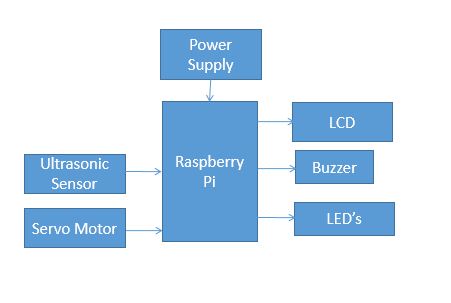
Block Diagram
Specifications
Hardware components:
- Raspberry pi
- Ultrasonic sensor
- Servo motor
- LED
- LCD
- Buzzer
- Power supply
Software requirements:
- PYTHON
- NOOBS
- VNC Viewer
- Advanced IP Scanner
Learning Outcomes
- Raspberry pi pin diagram and architecture
- How to install NOOBS software
- Setting up and installation procedure for Raspberry Pi
- How to connect Raspberry Pi through VNC viewer
- Introduction to Python3 IDE
- Commands in Python
- Basic coding in Python
- Working on Ultrasonic sensor
- How to interface Ultrasonic sensor with Raspberry Pi?
- Working on LED
- How to interface LED with Raspberry Pi?
- Working on LCD
- How to interface LCD with Raspberry Pi?
- Working on Buzzer
- How to interface Buzzer with Raspberry Pi?
- Working on Servo motor
- How to interface Servo motor with Raspberry Pi?
- Working on power supply
- About Project Development Life Cycle:
- Planning and Requirement Gathering((Hardware components, etc.,)
- Hardware development and debugging
- Development of the Project and Output testing
- Practical exposure to:
- Hardware tools.
- Solution providing for real time problems.
- Working with team/ individual.
- Work on Creative ideas.
- Project development Skills
- Problem analyzing skills
- Problem solving skills
- Creativity and imaginary skills
- Testing skills
- presentation skills
- Thesis writing skills


 Paper Publishing

Request Call Back
Would you like to receive a free callback now?
Choose the best time for callback:
Leave your message and we will contact you as soon as possible

6-2-85/B, Old Maternity Hospital Road, Thyagaraja Nagar, Tirupati, Andhra Pradesh – 517501
+91 9030333433
+91 9393939065
0877-2261612

Disclaimer - Takeoff Edu Group Projects are not associated or affiliated with IEEE in any way. The IEEE Projects mentioned here are mentioned in the context of student projects, whose ideas are derived from IEEE publications, not projects of or by IEEE.

