Privacy-Preserving Federated Deep Learning for Nomophobia Risk Prediction From Smartphone Usage Logs
Objective
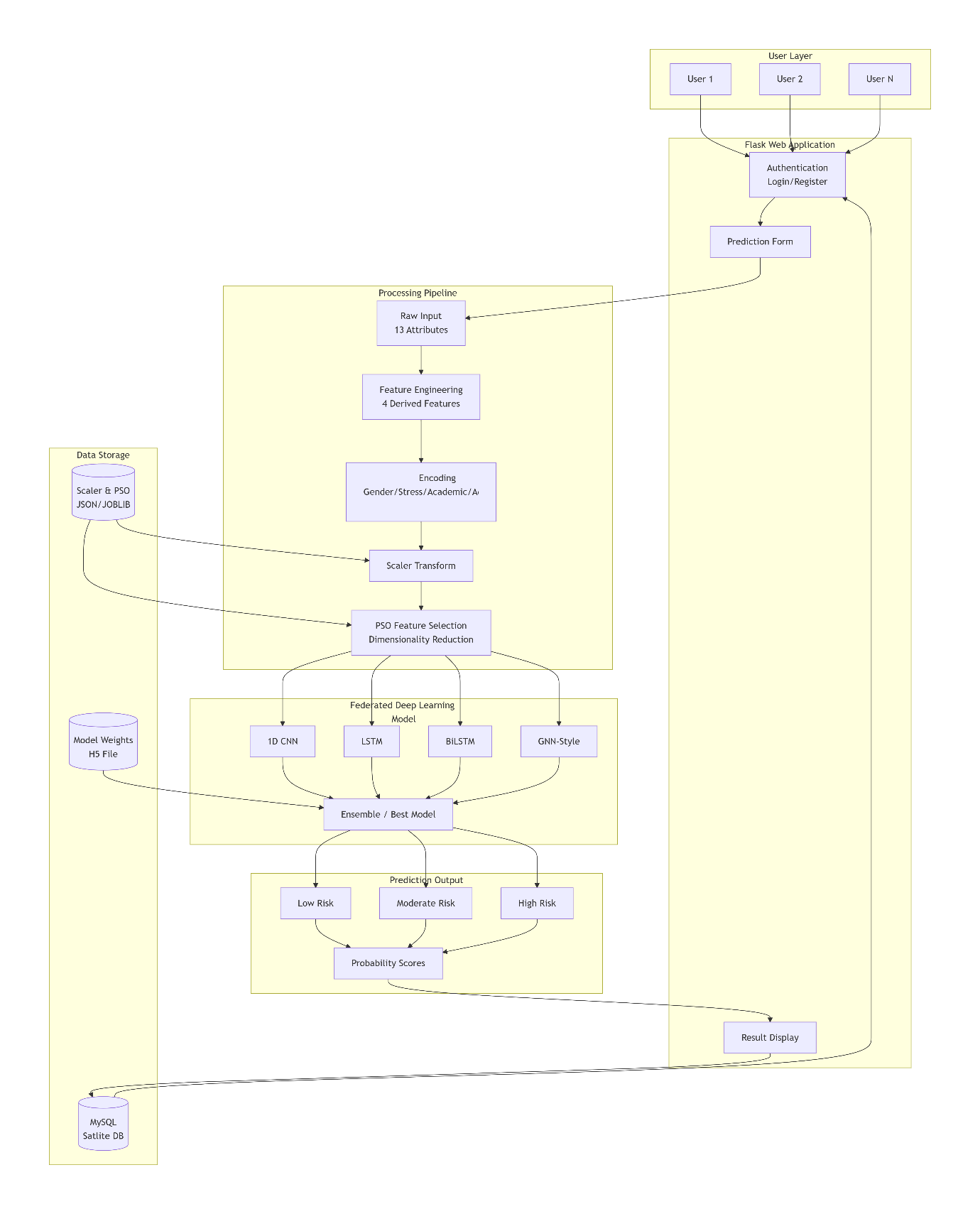
The primary objective of this project is to develop a privacy-preserving, intelligent system for predicting nomophobia risk using smartphone usage behavior. The proposed framework utilizes a Hybrid Federated Deep Learning approach to classify individuals into three risk levels: Low Risk, Moderate Risk, and High Risk. By integrating advanced deep learning models such as 1D CNN, LSTM, BiLSTM, and a GNN-style architecture under a federated learning environment, the system aims to achieve high prediction accuracy while ensuring complete user data privacy. Particle Swarm Optimization (PSO) is employed for optimal feature selection. Additionally, a real-time web application has been developed using the Flask framework to provide instant nomophobia risk assessment. The project focuses on building a scalable, secure, and efficient solution that supports early detection of nomophobia without compromising sensitive personal data.
Abstract
Nomophobia, the irrational fear of being without one’s mobile phone, has become a growing psychological concern worldwide. This research proposes a Privacy-Preserving Hybrid Federated Deep Learning framework for accurate nomophobia risk prediction based on smartphone usage logs. The framework enables decentralized training across multiple clients without sharing raw sensitive data, thereby ensuring user privacy. A large-scale synthetic dataset comprising approximately 50,000 user records was utilized, featuring 13 behavioral attributes and 4 engineered features. Particle Swarm Optimization (PSO) was applied for intelligent feature selection to improve model performance and reduce dimensionality. The study explores and evaluates hybrid federated deep learning models, including 1D CNN, LSTM, BiLSTM, and a GNN-style model, with the best-performing federated architecture achieving high accuracy in classifying users into three risk levels: Low, Moderate, and High.
A real-time Flask-based web application was developed, allowing authenticated users to input their smartphone usage patterns and instantly receive a nomophobia risk prediction with probability scores. By combining the strengths of hybrid deep learning models under a federated environment, the proposed system offers superior scalability, privacy protection, and real-time usability compared to traditional centralized approaches. This work presents a novel, ethical, and scalable solution for intelligent mental health monitoring in the digital era.
Keywords: Nomophobia, Federated Deep Learning, Privacy Preservation, Particle Swarm Optimization, Smartphone Addiction, 1D-CNN, LSTM, BiLSTM, Graph Neural Network, Digital Mental Health
NOTE: Without the concern of our team, please don't submit to the college. This Abstract varies based on student requirements.
Block Diagram
Specifications
SOFTWARE REQUIREMENS
Component
Specification
Operating System
Windows 10 / 11 (64-bit) or Linux (Ubuntu 20.04+)
Programming Language
Python 3.10.20
Web Framework
Flask
Deep Learning Framework
TensorFlow / Keras
Data Processing Libraries
Pandas, NumPy, Joblib
Other Libraries
MySQL Connector, JSON, Scikit-learn
Frontend Technologies
HTML5, CSS3, Bootstrap, JavaScript
Database
MySQL
IDE / Editor
Visual Studio Code / PyCharm
Model File Formats
.h5 (TensorFlow), .joblib, .json
Server Deployment
Localhost / Flask Development Server
HARDWARE REQUIREMENTS
Component
Minimum Specification
Recommended Specification
Processor
Intel Core i5 / AMD Ryzen 5
Intel Core i7 / AMD Ryzen 7
RAM
8 GB
16 GB or higher
Hard Disk
256 GB SSD
512 GB SSD or higher
Graphics Card
Integrated Graphics
NVIDIA GPU with CUDA support (optional for faster training)
Keyboard
Standard Windows Keyboard
Standard Windows Keyboard
Mouse
Two or Three Button Mouse
Two or Three Button Mouse
Monitor
Any (15-inch or above)
17-inch or above


 Paper Publishing

Request Call Back
Would you like to receive a free callback now?
Choose the best time for callback:
Leave your message and we will contact you as soon as possible

6-2-85/B, Old Maternity Hospital Road, Thyagaraja Nagar, Tirupati, Andhra Pradesh – 517501
+91 9030333433
+91 9393939065
0877-2261612

Disclaimer - Takeoff Edu Group Projects are not associated or affiliated with IEEE in any way. The IEEE Projects mentioned here are mentioned in the context of student projects, whose ideas are derived from IEEE publications, not projects of or by IEEE.

