Prioritizing Hospital Admission According to Emergency using Machine Learning
Objective
The objective of prioritizing hospital admission according to emergency using machine learning is to optimize patient care and resource allocation by identifying which patients require urgent medical attention and should be admitted to the hospital first. In emergency situations, there may be limited resources, such as hospital beds, medical equipment, and healthcare professionals, which can lead to delays in patient care and potentially worse outcomes.
Abstract
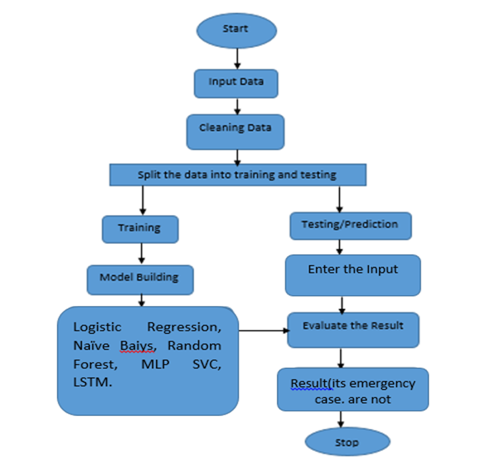
The use of artificial intelligence and machine learning techniques in emergency medicine has grown rapidly. This paper reviews and assesses studies in this field, categorizing them into three areas: prediction and detection of disease, prediction of need for admission, discharge, and mortality, and machine learning-based triage systems. In the first category, several studies have been conducted using machine learning algorithms. These studies used various machine learning techniques, including Logistic Regression, Naive Bias, Random Forest, MLP, SVC, LSTM, and datasets from electronic health records and medical imaging. The second category focuses on predicting the need for hospital admission, discharge, and mortality using machine learning algorithms. These studies have used various datasets, including electronic health records, laboratory data, and vital signs. The algorithms used in these studies include decision trees, random forests, and logistic regression models. Finally, the third category explores the development of machine learning-based triage systems for emergency departments. These studies have used various datasets, including vital signs and medical history, and machine learning techniques such as decision trees, artificial neural networks, and fuzzy logic. Overall, the studies reviewed in this paper demonstrate the potential of artificial intelligence and machine learning techniques in emergency medicine.
KEYWORDS: Logistic Regression, Naive Bias, Random Forest, MLP, SVC, LSTM
NOTE: Without the concern of our team, please don't submit to the college. This Abstract varies based on student requirements.
Block Diagram
Specifications
SOFTWARE FRONT END REQUIREMENTS
H/W Configuration:
Processor - I3/Intel Processor
Hard Disk -160 GB
RAM- 8 GB
S/W Configuration:
Operating System : Windows 7/8/10 .
Server side Script : HTML, CSS & JS.
IDE : Pycharm.
Libraries Used : Numpy, IO, OS, Django, keras.
Technology : Python 3.6+.


 Paper Publishing

Request Call Back
Would you like to receive a free callback now?
Choose the best time for callback:
Leave your message and we will contact you as soon as possible

6-2-85/B, Old Maternity Hospital Road, Thyagaraja Nagar, Tirupati, Andhra Pradesh – 517501
+91 9030333433
+91 9393939065
0877-2261612

Disclaimer - Takeoff Edu Group Projects are not associated or affiliated with IEEE in any way. The IEEE Projects mentioned here are mentioned in the context of student projects, whose ideas are derived from IEEE publications, not projects of or by IEEE.

