Predictive Modeling for Fetal Health: A Study of PCA Dimensionality Reduction
Objective
"The project “Predictive Modeling for Fetal Health: A Comparative Study of PCA for Dimensionality Reduction” focuses on classifying fetal health into Normal, Suspect, and Pathological categories. It uses the fetal health dataset and applies Principal Component Analysis (PCA) to reduce feature dimensions for better efficiency. Four machine learning models — Naive Bayes, Logistic Regression, Multi-Layer Perceptron (MLP), and Random Forest — are trained and compared for accuracy. The system evaluates model performance using metrics such as accuracy, precision, recall, and F1-score. A Flask-based web application is developed, enabling users to upload data, select models, and view predictions easily. "
Abstract
Predictive modeling in fetal health is essential for understanding the condition and development of a fetus. This project explores the application of machine learning algorithms to classify fetal health into three categories: Normal, Suspect, and Pathological. The study focuses on the use of Principal Component Analysis (PCA) for dimensionality reduction to improve computational efficiency and model performance. Four classification algorithms are implemented: Naive Bayes, Logistic Regression, Multi-Layer Perceptron (MLP), and Random Forest Classifier. The dataset contains multiple features derived from cardiotocography recordings, providing detailed information on fetal heart rate and uterine activity. Data preprocessing steps include handling missing values, feature scaling, and applying PCA to reduce redundant information. The models are evaluated using accuracy, precision, recall, and F1-score to determine their effectiveness in fetal health classification. Comparative analysis highlights how PCA influences prediction performance and identifies the most suitable algorithm for the dataset. The system is deployed as a web application using Flask, with modules for Home, Register, Login, Classification, and Logout, providing a simple interface for interacting with the predictive models. The study demonstrates that dimensionality reduction can enhance model efficiency without significantly affecting accuracy, offering a structured approach for fetal health assessment using machine learning.
Keywords: Fetal health, Predictive modeling, PCA, Dimensionality reduction, Naive Bayes, Logistic regression, Random Forest, MLP, Classification, Machine learning.
NOTE: Without the concern of our team, please don't submit to the college. This Abstract varies based on student requirements.
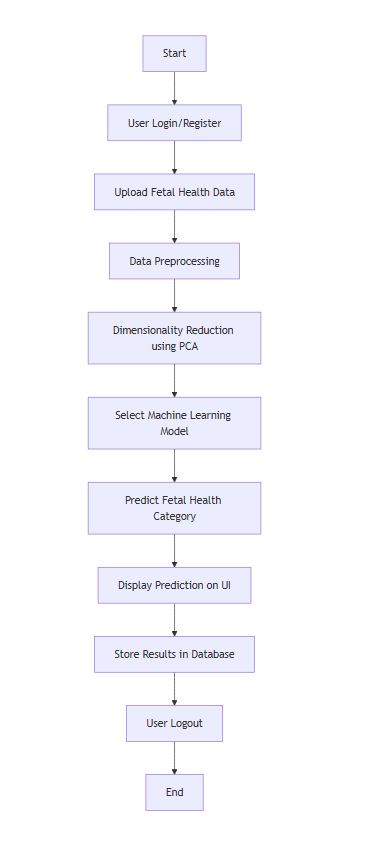
Block Diagram
Specifications
H/W CONFIGURATION:
Processor - I3/Intel Processor
Hard Disk - 160GB
Key Board - Standard Windows Keyboard
Mouse - Two or Three Button Mouse
Monitor - SVGA
RAM - 8GB
S/W CONFIGURATION:
• Operating System : Windows 7/8/10
• Server side Script : HTML, CSS, Bootstrap & JS
• Programming Language : Python
• Libraries : Flask, Pandas, MySQL. Connector, Scikit-Learn, pytorch
• IDE/Workbench : VS Code
• Technology : Python 3.8+
• Server Deployment : Xampp Server

Demo Video


Request for Video
 Paper Publishing
Request Call Back
Would you like to receive a free callback now?
Choose the best time for callback:
Leave your message and we will contact you as soon as possible

6-2-85/B, Old Maternity Hospital Road, Thyagaraja Nagar, Tirupati, Andhra Pradesh – 517501
+91 9030333433
+91 9393939065
0877-2261612

Disclaimer - Takeoff Edu Group Projects are not associated or affiliated with IEEE in any way. The IEEE Projects mentioned here are mentioned in the context of student projects, whose ideas are derived from IEEE publications, not projects of or by IEEE.

