Prediction of Remaining Useful Life for AeroEngines
Objective
The motive of this project is to design a machine learning–based framework for accurately predicting the Remaining Useful Life (RUL) of aeroengines. Conventional maintenance practices often depend on fixed schedules or manual inspections, which can cause unnecessary servicing or unexpected failures. By analyzing sensor data, operational parameters, and historical performance records, the system aims to estimate the progression of engine degradation. This allows airlines and maintenance teams to move from reactive approaches to predictive strategies, ensuring safety, reducing downtime, optimizing maintenance costs, and improving the reliability and efficiency of aeroengine operations.
Abstract
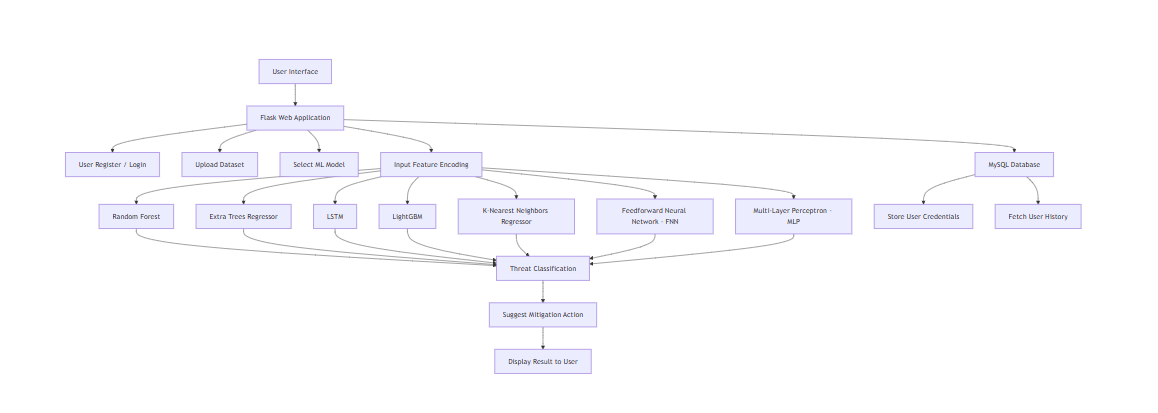
The project, “Prediction of Remaining Useful Life for AeroEngines”, focuses on developing a data-driven framework to estimate the remaining operational lifespan of aircraft engines, known as Remaining Useful Life (RUL). Accurate RUL prediction is critical for proactive maintenance, safety assurance, and reducing unexpected engine failures in aviation. This work employs machine learning techniques to analyze sensor data collected from aeroengines during operational cycles. The system allows users to upload engine sensor datasets in CSV format, and it utilizes pre-trained regression models, including Extra Trees Regressor, Random Forest, Gradient Boosting, XGBoost, and neural networks, to predict engine health status and RUL. Input features, such as temperature, pressure, and vibration readings from multiple sensors, are processed and fed into the models to generate precise RUL estimates. The predicted RUL is classified into three categories: critical, warning, and normal, accompanied by actionable maintenance suggestions for each class. A web-based interface, implemented using Flask, provides interactive functionalities for registration, login, dataset upload, model selection, and real-time RUL prediction. The system integrates database support through MySQL for secure user management and data storage. Experimental results demonstrate that ensemble learning and neural network models can achieve high predictive accuracy, enabling reliable and timely decision-making for aeroengine maintenance. The approach ensures safety, optimizes maintenance schedules, and reduces operational costs by preventing unscheduled failures.
Keywords: Remaining Useful Life (RUL), Aeroengine, Machine Learning, Predictive Maintenance, Regression Models, Ensemble Learning, Sensor Data, Flask, Extra Trees Regressor, XGBoost.
NOTE: Without the concern of our team, please don't submit to the college. This Abstract varies based on student requirements.
Block Diagram
Specifications
SOFTWARE REQUIREMENS
Operating System : Windows 7/8/10
Server side Script : HTML, CSS, Bootstrap & JS
Programming Language : Python
Libraries : Flask, Pandas, Torch, Keras, Sklearn,Numpy , Seaborn
IDE/Workbench : VSCode
Server Deployment : Xampp Server
Database : MySQL
HARDWARE REQUIREMENTS
Processor - I3/Intel Processor
RAM - 8GB (min)
Hard Disk - 128 GB
Key Board - Standard Windows Keyboard
Mouse - Two or Three Button Mouse
Monitor - Any

Demo Video


Request for Video
 Paper Publishing
Request Call Back
Would you like to receive a free callback now?
Choose the best time for callback:
Leave your message and we will contact you as soon as possible

6-2-85/B, Old Maternity Hospital Road, Thyagaraja Nagar, Tirupati, Andhra Pradesh – 517501
+91 9030333433
+91 9393939065
0877-2261612

Disclaimer - Takeoff Edu Group Projects are not associated or affiliated with IEEE in any way. The IEEE Projects mentioned here are mentioned in the context of student projects, whose ideas are derived from IEEE publications, not projects of or by IEEE.

