PREDICTION OF MULTILUNG DISEASE USING DEEPLEARNING
Objective
The objective of this project is to develop a deep learning-based system for the automated detection and classification of multiple lung diseases from chest radiographs. Specifically, it aims to accurately identify six lung conditions: Normal, Pneumonia (Bacterial and Viral), COVID-19, Tuberculosis, and Emphysema. By leveraging advanced algorithms such as Convolutional Neural Networks (CNN), MobileNet, and DenseNet, the project seeks to enhance diagnostic efficiency, enabling faster and more accurate detection. The system aims to assist healthcare professionals in identifying lung diseases at an early stage, thus contributing to improved patient outcomes and timely interventions.
Abstract
The prediction of multi-lung diseases using deep learning techniques from chest radiographs has emerged as a crucial task for aiding early diagnosis and improving healthcare outcomes. This study presents an innovative approach for the detection of six distinct lung conditions, namely, Normal, Pneumonia (Bacterial and Viral), COVID-19, Tuberculosis, and Emphysema, leveraging the ChestX6 dataset, a high-quality collection of labeled chest X-ray images. We explore the use of convolutional neural networks (CNN), MobileNet, and DenseNet to classify these diseases effectively. Each algorithm is evaluated on their ability to accurately classify chest radiographs into their respective categories, providing insights into their strengths and weaknesses. CNN, being a traditional and widely used deep learning model, serves as the baseline for comparison. MobileNet and DenseNet are utilized for their efficiency in handling complex image data while maintaining computational feasibility. The model's performance is assessed using various metrics, including accuracy, precision, recall, and F1-score, ensuring robust evaluation across multiple disease classes. The results show that deep learning-based models can significantly improve the accuracy of diagnosing multiple lung diseases, thus enabling faster and more reliable detection, which is critical in managing pandemics like COVID-19. This research underscores the potential of AI in transforming medical diagnostics and offers a pathway to automate and streamline the process of disease detection in chest radiographs.
Keywords: Multi-lung disease detection, Chest radiographs, Deep learning, Convolutional neural networks, MobileNet, DenseNet, Pneumonia, COVID-19, Tuberculosis, Emphysema.
NOTE: Without the concern of our team, please don't submit to the college. This Abstract varies based on student requirements.
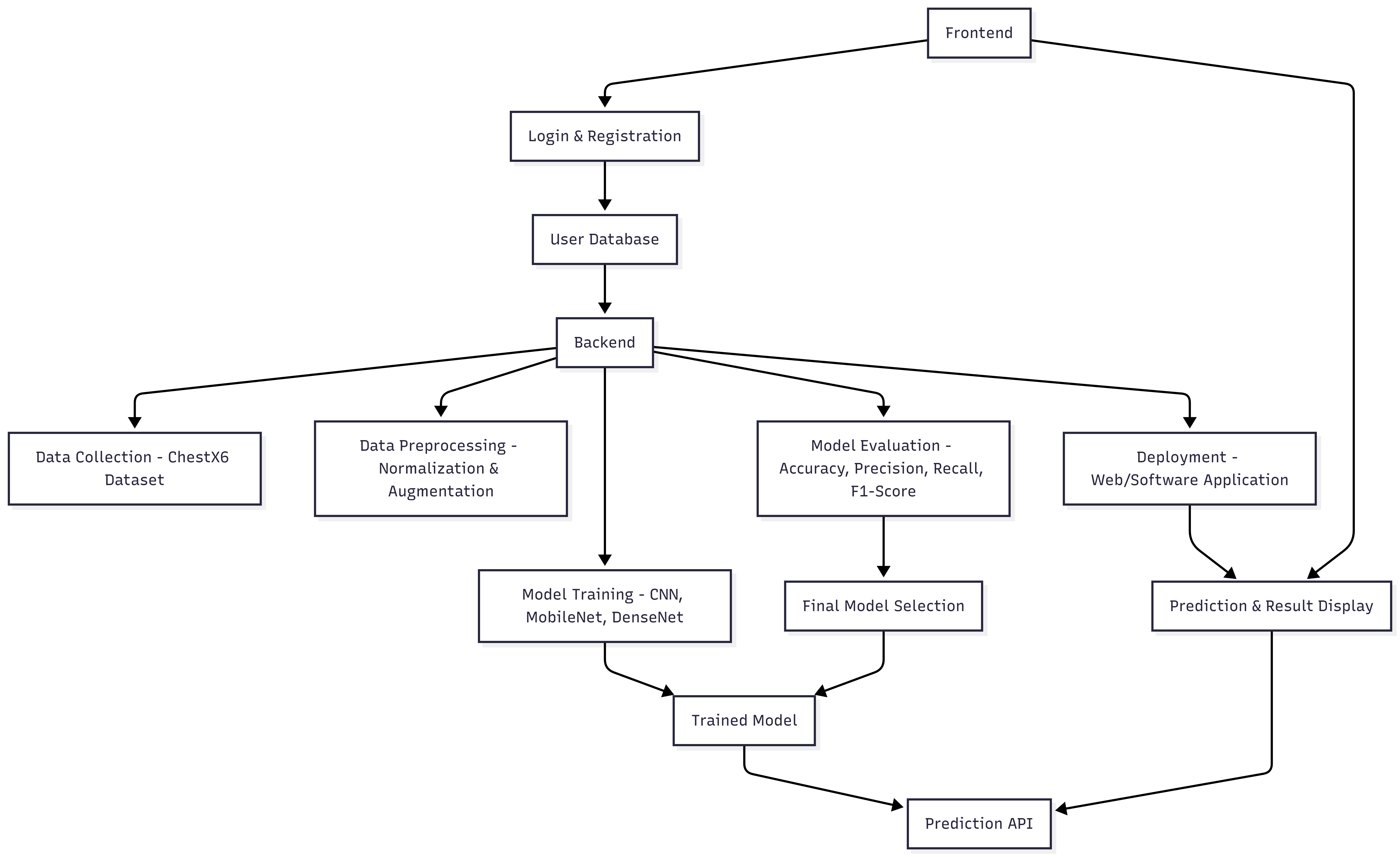
Block Diagram
Specifications
SOFTWARE REQUIREMENS
Operating System : Windows 7/8/10
Server side Script : HTML, CSS, Bootstrap & JS
Programming Language : Python
Libraries :Flask, Torch, Tensorflow, Pandas, Mysql.connector
IDE/Workbench : VSCode
Server Deployment : Xampp Server
Database : MySQL
HARDWARE REQUIREMENTS
Processor - I3/Intel Processor
RAM - 8GB (min)
Hard Disk - 128 GB
Key Board - Standard Windows Keyboard
Mouse - Two or Three Button Mouse
Monitor - Any


 Paper Publishing

Request Call Back
Would you like to receive a free callback now?
Choose the best time for callback:
Leave your message and we will contact you as soon as possible

6-2-85/B, Old Maternity Hospital Road, Thyagaraja Nagar, Tirupati, Andhra Pradesh – 517501
+91 9030333433
+91 9393939065
0877-2261612

Disclaimer - Takeoff Edu Group Projects are not associated or affiliated with IEEE in any way. The IEEE Projects mentioned here are mentioned in the context of student projects, whose ideas are derived from IEEE publications, not projects of or by IEEE.

